A Question I Hope To Ask More In 2013 – Who Is Doing The Teaching?

139f63a5-e1c3-4250-9823-40c938d8e15b

It doesn’t seem like that long ago when the number of administrators (and educators for that matter) sharing their stories online was scarce.  Aside from the excitement of seeing our numbers grow over the last couple of years, I continue to be energized by the potential we have to improve our schools as increasing numbers of educators share what is happening in their classrooms, schools, and communities.  Allowing others to see concrete examples of progressive ideas being implemented successfully gives others the confidence that they are not out on a limb by themselves when they consider taking similar risks.

While I am grateful to be part of a community of educators that pushes my thinking daily, there is a group out there that influences me even more, our students.   In fact, I’ll tell you that the question on  the picture above (Who is doing the teaching?) is really a trick question. The real question that we need to ask ourselves is who is doing the learning?  Or better yet, as individuals, we need to consider whether we are continuous learners ourselves.

Personally, I am constantly looking at my own daily routine and thinking about whether or not I am practicing what I preach. Am I spending too much reading, blogging, tweeting, etc?   Am I just consuming details about the efforts of others?  What am I contributing myself?

The moments that tend to impact me most are opportunities to learn with others (in-person).  I feel fortunate to be in a district where there are formal and informal opportunities to learn with and from both students and staff. In looking ahead to 2013, I hope to see the line between teachers and learners continue to blur in our schools. I hope to see more public examples of this to share within and beyond our school community.

Here are a few of my favorites from 2012!
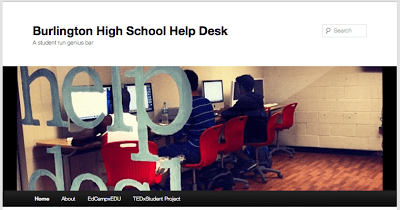
#1 Burlington High School Student Help Desk Website

#2 Marshall Simonds Middle School Students PSA On “The R Word”

#3 Learning Every Day in Burlington – Features a daily post from a learner in our school community. 
A New Blog From Richard Byrne…Focused On iPad Apps!

Richard Byrne’s Free Technolog For Teachers Blog has been one of the top resources for educators trying to integrate technology into their classrooms for quite some time.  In fact Richard’s blog was again selected as the Best EdTech Blog in this year’s Edublog awards. What makes Richard’s blog so useful is the fact that he reviews all of the resources that he posts and also has a number of publications and videos that can help teachers in their efforts to utilize more digital resources.

Well, Richard has added to his web-presence with the creation of a new blog geared towards educators looking to implement iPads in their classrooms.  At the beginning of December, Richard started a new blog called iPad Apps for School.  I have already made it a must follow and added it to my RSS feed.

Thanks for the early Christmas present Richard!

Here are a few recent posts from the new blog worth checking out:

10 Great Apps for a Teacher’s New iPad

An Augmented Reality Math Game
MeeGenius Puts Great Children’s Stories on iPads
Maily for iPad Gives Students a Safe Place to Learn to Email

Enhanced by Zemanta

Happy Holiday Wishes!

Wishing all of our students, staff, their families and friends a wonderful holiday season and a Happy New Year.  As we head off on our winter break, I leave you with some pictures from our schools this week.

image (1)
Mrs. Guanci’s First Graders 
Adrianna
Adriana, grade one at Francis Wyman
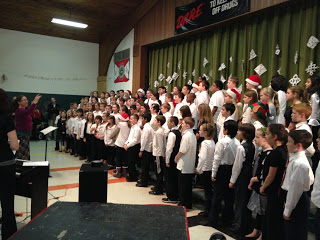
Pine Glen Holiday Concert

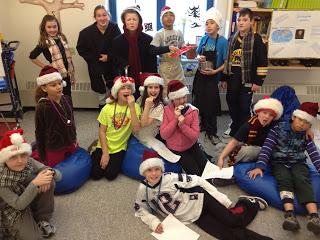
Memorial School – Mrs. Burns Reading Class

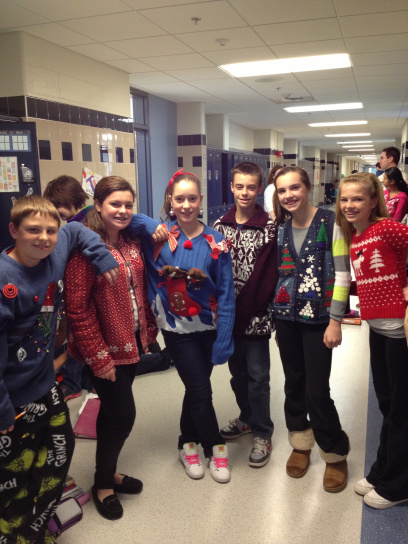
Ugly Sweater Day at Marshall Simonds

"It’s Just A Christmas Ribbon"

photo-1

When my first-grader asked me about the ribbon on my jacket yesterday afternoon, I was not sure exactly what to say. A few thoughts zoomed through my head as I settled on my response which was, “It’s just a Christmas ribbon.”

While I feel a sense of relief that my six-year old doesn’t understand the nature of the events that occurred in Newtown, CT a week ago today, the reality is that what the ribbon symbolizes most to me is the precious gift that we have in our nation’s children.  As a parent of an elementary student, I have been riding the wave of emotions that so many of us have experienced in the last week.  I am continually amazed at so many of her qualities, ones that she shares with her elementary-aged peers, qualities like happiness, resilience, and innocence just to name a few.

The fallout from the events last week have impacted so many of us due to the fact that we lost 20 little ones in such a a violent and unfathomable way. As a nation, we are struggling to gain back our feelings of happiness, resilience and innocence. But while things will never be the same, I pray that time will allow us to overcome our new fears for our children so that we can be united in our unending efforts to ensure that our students our emotionally and physically safe.

There are just too many levels to this conversation for a quick and easy solution. But when I look down at the ribbon on my jacket today, my initial thoughts of this national tragedy have moved from anger to acceptance. The initial horrific pictures in my head have moved on to more positive visions. These are visions of an amazingly resilient community who has come together to support one another in the worst of times.  They are stories of strength and forgiveness from those who have been affected the most.

So what I could not say to Mary Clare is this:

The ribbon is a symbol of a community that has gone through a horrific tragedy and in dealing with these events the people of this community have shown an entire nation inconceivable resilience.  It is so much more than “just a Christmas ribbon…”

Back to School With New Worries, But The Same Plan

Official seal of Newtown, Connecticut
Official seal of Newtown, Connecticut (Photo credit: Wikipedia)
I dropped my six-year old daughter off at school Friday at about 8:30.  As I walked her in the front door, we were greeted by the Principal who greets every child who walks in the door at the school each morning. Then we ran into my daughter’s teacher who asked if she wanted to go to the classroom early with her since the buses were a few minutes from arriving. I drove away from the school feeling very much at peace with the fact that my daughter would have another great day in her first grade class and would return home safely at the end of the day.

But before my daughter finished her school day, our world was turned upside-down due to the unimaginable occurrence at Sandy Hook Elementary School in Newtown, Connecticut. I am not going to rehash the details here as we are all aware of the unfathomable events that took place.  However, the reality is that as both a parent and administrator I now have new worries to contend with that never would have entered my mind before yesterday.  Parents like me, who sent their kids off to school feeling the same sense of security I did with my daughter, did not have their kids return home safely.

The emotional roller coaster that we have all been on since Friday is something that is unprecedented.  But in spite of all of this, my first grader, my seventh grader, my ninth grader, and my three step-children will all return to their schools tomorrow where they will be put in the hands of wonderfully caring teachers and administrators just like those at Sandy Hook.

As we get ready to start the new week, I have been searching for words to help make sense of this. The words of Robert Evans, Ed.D. and Mark Kline, Psy.D. from Wellesley’s community mental health agency sum up the uncomfortable truth we are all grappling with:

“There is no technology or template for coping with this kind of event. We feel shock and disbelief, sorrow for the victims, anger at its unfairness…And most of us think immediately about how to be helpful to our children.”

Our ultimate goal as parents and educators is to do everything in our power to support our children during this traumatic period.  Again Evans and Kline have advice for us:

Above all, coping with such an awful event is not primarily a matter of technique, not something best handled by a particular set of tactics that deviate sharply from one’s familiar patterns of communication. The regular routines of both school and family life are, all by themselves, a source of comforting continuity and assurance. Adults will rarely go wrong by relying on what is most basic between them and their children—caring and connection. At these times, your presence—your simply being with them, their knowing that you are available—can be just what they need.”

We will be present tomorrow and we will continue to care deeply for our students.  There will never be an alternative.

Enhanced by Zemanta

A Thoughtful Post From Principal Lyons at Pine Glen

This was posted by Pine Glen Principal John Lyons on his blog last night:

Our thoughts and prayers go out tonight to the many families in Newtown, Connecticut who are dealing with the terrifying events that happened today.  I know this area of Connecticut well having family that live in the state.  These events are very close to home.  I imagine that like me you gave your young children a big hug when arriving home today. 


Senseless violence is very difficult for adults to understand and even more the case for young children.  One of the best things we can do for our children this weekend is maintain a normal routine and follow our regular family structure.  Children love having structure and being around friends and family.  When we provide structure, we help children to not worry and lessen the chance of anxiety.

Furthermore, structure promotes physical health through regularly scheduled sleep, exercise and meals.  It is important that adults don’t show our anxiety about the events and stress that violence is never a solution to a problem.


My wife and I are doing a media blackout for our two young daughters this weekend.  The
limiting of television viewing is helpful for all children and particularly will be helpful this weekend.
If children do gain access to information about the tragedy in Connecticut, it is vital to have conversations as these events can quickly be misunderstood and anxiety producing in young children.  In such cases it is critical to monitor children’s emotional
state.  During times of tragedy it is very important that we reassure children they are safe.  If children ask questions, it is helpful to have answers that are simple and brief. 


If your children become aware of this tragedy and have concerns, please let them know that they are safe at Pine Glen Elementary School in Burlington, MA.  Please let them know that Mr. Lyons and their teacher(s) will keep them safe.  If you feel that your child needs more reassurance, our guidance counselor, Ms. May, school psychologist, Ms. Garneau and I will be available to meet with him/her on Monday to talk about how hard we work to make our school a safe environment for life-long learning.


John Lyons, M.S.
Ed.
Principal 
Pine Glen Elementary School
Enhanced by Zemanta

Talking to Children about Violence from the NASP

As both a parent and an administrator, I am at a loss for words following today’s tragic events in Newtown, CT.  Fortunately, there are experts like the National Association of School Psychologists, we can turn to that can help us explain the inexplicable.  

Thanks to Dr. Conti for posting this resource on his blog:

Talking to Children About Violence: Tips for Parents and Teachers
High profile acts of violence, particularly in schools, can confuse and frighten children who may feel in danger or worry that their friends or loved-ones are at risk. They will look to adults for information and guidance on how to react. Parents and school personnel can help children feel safe by establishing a sense of normalcy and security and talking with them about their fears.

  1. Reassure children that they are safe. Emphasize that schools are very safe. Validate their feelings. Explain that all feelings are okay when a tragedy occurs. Let children talk about their feelings, help put them into perspective, and assist them in expressing these feelings appropriately.
  2. Make time to talk. Let their questions be your guide as to how much information to provide. Be patient. Children and youth do not always talk about their feelings readily. Watch for clues that they may want to talk, such as hovering around while you do the dishes or yard work. Some children prefer writing, playing music, or doing an art project as an outlet. Young children may need concrete activities (such as drawing, looking at picture books, or imaginative play) to help them identify and express their feelings.
  3. Keep your explanations developmentally appropriate.
    • Early elementary school children need brief, simple information that should bebalanced with reassurances that their school and homes are safe and that adults are there to protect them. Give simple examples of school safety like reminding children about exterior doors being locked, child monitoring efforts on the playground, and emergency drills practiced during the school day.
    • Upper elementary and early middle school children will be more vocal in asking questions about whether they truly are safe and what is being done at their school. They may need assistance separating reality from fantasy. Discuss efforts of school and community leaders to provide safe schools.
    • Upper middle school and high school students will have strong and varying opinions about the causes of violence in schools and society. They will share concrete suggestions about how to make school safer and how to prevent tragedies in society. Emphasize the role that students have in maintaining safe schools by following school safety guidelines (e.g. not providing building access to strangers, reporting strangers on campus, reporting threats to the school safety made by students or community members, etc.), communicating any personal safety concerns to school administrators, and accessing support for emotional needs.
  4. Review safety procedures. This should include procedures and safeguards at school and at home. Help children identify at least one adult at school and in the community to whom they go if they feel threatened or at risk.
  5. Observe children’s emotional state. Some children may not express their concerns verbally. Changes in behavior, appetite, and sleep patterns can indicate a child’s level of anxiety or discomfort. In most children, these symptoms will ease with reassurance and time. However, some children may be at risk for more intense reactions. Children who have had a past traumatic experience or personal loss, suffer from depression or other mental illness, or with special needs may be at greater risk for severe reactions than others. Seek the help of mental health professional if you are at all concerned.
  6. Limit television viewing of these events. Limit television viewing and be aware if the television is on in common areas. Developmentally inappropriate information can cause anxiety or confusion, particularly in young children. Adults also need to be mindful of the content of conversations that they have with each other in front of children, even teenagers, and limit their exposure to vengeful, hateful, and angry comments that might be misunderstood.
  7. Maintain a normal routine. Keeping to a regular schedule can be reassuring and promote physical health. Ensure that children get plenty of sleep, regular meals, and exercise. Encourage them to keep up with their schoolwork and extracurricular activities but don’t push them if they seem overwhelmed.
Suggested Points to Emphasize When Talking to Children

  • Schools are safe places. School staff work with parents and public safety providers (local police and fire departments, emergency responders, hospitals, etc.) to keep you safe.
  • The school building is safe because … (cite specific school procedures).
  • We all play a role in the school safety. Be observant and let an adult know if you see or hear something that makes you feel uncomfortable, nervous or frightened.
  • There is a difference between reporting, tattling or gossiping. You can provide important information that may prevent harm either directly or anonymously by telling a trusted adult what you know or hear.
  • Don’t dwell on the worst possibilities. Although there is no absolute guarantee that something bad will never happen, it is important to understand the difference between the possibility of something happening and the probability that it will affect our school.
  • Senseless violence is hard for everyone to understand. Doing things that you enjoy, sticking to your normal routine, and being with friends and family help make us feel better and keep us from worrying about the event.
  • Sometimes people do bad things that hurt others. They may be unable to handle their anger, under the influence of drugs or alcohol, or suffering from mental illness. Adults (parents, teachers, police officers, doctors, faith leaders) work very hard to get those people help and keep them from hurting others. It is important for all of us to know how to get help if we feel really upset or angry and to stay away from drugs and alcohol.
  • Stay away from guns and other weapons. Tell an adult if you know someone has a gun. Access to guns is one of the leading risk factors for deadly violence.
  • Violence is never a solution to personal problems. Students can be part of the positive solution by participating in anti-violence programs at school, learning conflict mediation skills, and seeking help from an adult if they or a peer is struggling with anger, depression, or other emotions they cannot control. 

NASP has additional information for parents and educators on school safety, violence prevention, children’s trauma reactions, and crisis response at www.nasponline.org. ©2006, National Association of School Psychologists, 4340 East West Highway #402, Bethesda, MD 20814


Enhanced by Zemanta

1:1 iPad Plans at MSMS Taking Shape

Originally posted on the Marshall Simonds Learning Commons Blog:

-By Mr. Dexter, Library Media Specialist
toolbox
On Monday’s Professional Development Day, Marshall Simonds teachers were presented an overview of the 1:1 iPad plan by Assistant Superintendent Patrick Larkin, Director of Technology Integration Dennis Villano and the BPS Ed Tech Team. Beyond logistical details, the teachers were given time to learn about foundation apps and load them onto their iPads. Andy Marcinek and Tim Calvin, who both work at BHS as Educational Technology teachers provided MSMS staff with vital insight on how the 1:1 environment can provide teachers and students with a more engaging learning environment. The staff also had the benefit of learning from BHS Help Desk students Sidd Chhayani and RJ Dalton .
MSMS has had the advantage of being on the cutting-edge of technology for many years, so this transition will be a smoother one compared with many other schools. Dennis Villano mentioned during his presentation,

“Teachers at MSMS have always been willing to try new things.”

The foundational apps mentioned during the PD day were:
big-evernote-iconEvernotescreenshot2011-09-25at8-35-54amExplain Everything
boxDropboxnotability-app-iconNotability
google-drive-iosDrive
The iPad is simply another tool to add to the teacher’s toolbox. It is very exciting to see the potential of the 1:1 environment starting to take shape. I am sure this exciting learning environment will have its growing pains, but I am very excited about what is to come.