The end of this week came with the video released in Memphis showing five police officers brutally beating a black man, Tyre Nichols, who later died of his injuries. A couple of articles I read as I try to learn more about this man whose life was ended prematurely due to another case of unnecessary violence by police against a black person in this country:
Learning for Justice has reposted its resources for Discussing Race, Racism and Police Violence which was first created in 2014. It outlines how to facilitate conversations with students while also not adding to the trauma black students may be feeling.
This week’s Throughline podcast episode was certainly timely. The episode noted the following “In the United States, polls indicate that many people believe that law and order is the only thing protecting us from the savagery of our neighbors, that the fundamental nature of humanity is competition and struggle.”
The episode goes onto share the Two Wolves story which is often attributed to the Cherokee: “An old man says to his grandson, there’s a fight going on inside me. It’s a terrible fight between two wolves. One is evil, angry, greedy, jealous, arrogant and cowardly. The other is good, peaceful, loving, modest, generous, honest and trustworthy. These two wolves are also fighting within you and inside every other person, too. After a moment, the boy asks, which wolf will win? The old man smiles – the one you feed.”
The episode also highlights Veneer Theory, a theory based on the belief that humans are basically selfish and evil and need “civilization” to save them. The episode offers the contrasting points of view of 17th Century philosopher Thomas Hobbes and 18th Century philosopher Jean-Jacques Rousseau. Hobbes was a proponent of a strong government and did not think human beings would be able to refrain from killing each other, or from devolving into a state of mutual destruction without such a government. Author Rebecca Solnit noted the following:
“Hobbes’s idea that somehow you need authoritarian structures to control people corresponds really well to imperialism and colonialism, people who saw themselves as civilization imposing order on chaos.”
Jean-Jacques Rousseau, on the other hand, believed the lives of human beings in the state of nature was actually pretty good. Dutch historian Rutger Bregman summed up Rousseau’s thinking as follows:
“We were quite healthy. We had lots of exercise. We had a varied diet, and it was pretty peaceful as well. But then everything went wrong when we gave up our liberty, and we invented private property, and we settled down in villages and cities, and we created this thing called civilization.”
Ultimately, as we hear the varying narratives about incidents and events where there are various points of view (i.e. the murder of a black man by police), what wolf is being fed? Can we have a full view without knowing our country’s history and without having a good sense of our own identity and privilege?
Speaking of history
The news out of Florida this week was that Governor DeSantis is looking at limiting what topics we can allow our students to learn about. This article from NPR gets into the discussion about the proposed ban on African American Studies in the Sunshine State. NEA President Becky Pringle summed things up with the following statement:
“When we censor classes and whitewash lesson plans, we harm our students and do them a deep disservice.”
Getting back to the Throughline episode above, what wolf does this narrative feed?
News Literacy is more critical than ever
As I watch some news outlets try to rationalize the killing of Tyre Nichols, I am struck by the irony that this past week The News Literacy Project just completed their fourth annual National News Literacy Week. This non-partisan organization has amazing resources to help educators guide students (and adults) in being savvier about what they are reading and watching. This probably should have been mandated for all students back in 1987 when the FCC abolished the Fairness Doctrine. Here is a list of resources for students (and adults) that can help us all better meet the main objective of the News Literacy Project and “determine the credibility of news and other information and to recognize the standards of fact-based journalism to know what to trust, share and act on.”
Concluding this week’s writing with the following reminders that resonated from yesterday’s webinars from the News Literacy Project:
Opinion Journalism should meet the following standards:
Credible opinion pieces are based on verified facts and employ sound, logical reasoning.
Opinion journalism does not seek to avoid bias or ignore opposing views.
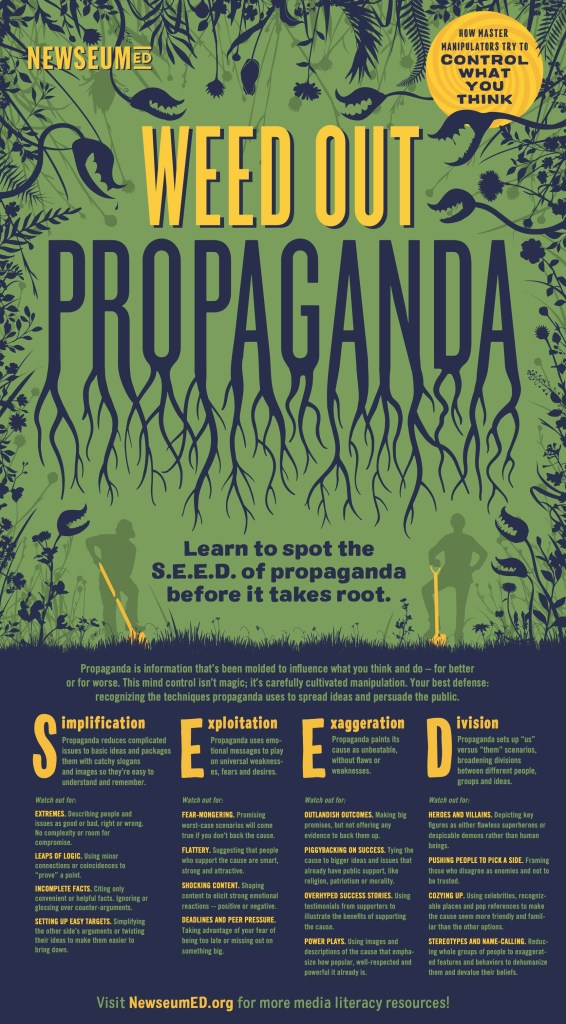
Common Propaganda Techniques
Simplification – Making a complicated idea seem very simple.
Exploration – Manipulating emotions rather than weighing facts.
Exaggeration – Making its cause seem stronger or more popular than it is.
Division – Attempting to broaden and exploit the gap between “us” and “them”
A Boston Globe Article this week highlighted a unique experiential learning program that started in 1971 called Sidetrack. This program was a partnership between the predominantly white suburban community of Lincoln, MA, and the predominantly black urban community of Roxbury. The program was comprised of two classes of 7th graders and each class would have 50 percent of its students from Roxbury and the other 50 percent of the class from Lincoln and the classes would each spend one half of the year in each of the two communities involved.
Despite the fact that the program showed great promise, the critics won out and the program ended after a year due to a lack of enrollment of Lincoln students. As Peter Thomson, both the author of the article and a student in the program put it, “Sidetrack and its vision would get mired in suburban ambivalence and recede into history.” He later adds, “The biggest challenge to school integration programs has always been getting white families and communities to buy in.”
What does an unwavering commitment to the work of diversity, equity, inclusion, and justice work look like? I mentioned this last month and shared a t-chart from the San Francisco Coalition of Essential Small Schools on what this unwavering discourse sounds like between educators. I also wonder what this unwavering discourse sounds like and looks like in classrooms and among students, families, and community members…
As an ardent CrossFitter, I made the connection to the importance of muscle memory in regards to improving on so many of the movements we do at the gym. A poor movement pattern repeated over time can result in a plateau or even an injury. When it comes to self-compassion, I can’t help remembering a quote from Dan Harris from 10-percent Happier and ABC News where he said, “The voice in my head is an asshole.” I have tried to drown out this voice by remembering the following words from Brené Brown: “Talk to yourself the way you talk to someone you love.”
Just like a poor physical movement pattern, we can be better with thought patterns and catching the negative voice earlier and finding ways to interrupt that critical voice. Whether it is stopping for a few breaths, going for a walk, or just sitting in the negative feeling and thinking about where it is coming from, all of these are ways that I can try and catch myself and not carry that negative energy into other spaces. This mental muscle memory is also something that I can reinforce and get stronger with.
Anyway, I hope this resonates for some others. Thanks to Jen B. for sharing Laura Brewer’s podcast with me. I will definitely be diving into past episodes in the weeks ahead. Also thanks to my awesome community members at CrossFit 133 for engaging in the self-compassion conversation!
Unpacking the White Innocence Playbook – This episode featured Dr. Melanie Bertrand from the University of Arizona and Dr. Carrie Sampson from Arizona State University. This idea of white innocence actually began in legal studies and Richard Orosco’s has taken this same framework to look at public schooling. The episode highlighted the following 4 discursive strategies of white innocence:
How to Liberate Your Consciousness with Dr. Michelle Pledger – This episode features Dr. Pledger who is the Director of Liberation at the Center for Research on Equity and Innovation and the author of LIBERATE! Pocket-Sized Paradigms for Liberatory Learning. Dr. Pledger defined liberation as “An existence of authenticity, belonging and contribution…A space where people can feel belonging by being their authentic selves.” She also noted the distinction between fitting in and belonging and that individuals who feel belonging “are not just contributing into something that already exists.”
If you want to learn more about Culturally Relevant Pedagogy, there is no one better than Dr. Ladson-Billings to learn from. This video is from a presentation done back in August for the Minnesota Historical Society. This is one I will watch again, but here are a few of my initial takeaways:
Her thoughts on Critical Race Theory (CRT). “(From the perspective of those decrying it) CRT is everything we don’t like.” Dr. Billings perspective is that “CRT is teaching the truth about our history.”
She describes Culturally Responsive Pedagogy as an equilateral triangle, one where all sides need to be equal. The three sides are composed of Academic Achievement/Student Learning, Cultural Competence, and Socio-political critical consciousness. She advocates for the use of primary source documents and gives some great examples on how teachers can use them in a culturally relevant way to “make the familiar strange” by asking inquiry-based questions.
Quote I’m Pondering as we celebrate a long weekend in honor of Dr. Martin Luther King Jr.
Happy New Year! Do you have any resolutions for 2023 or new goals? I am not a big resolution person, having failed at so many in the past that I have stayed away from them for a while. Instead, I spent a lot of time thinking about a word that I would focus on for 2023. Being on a sabbatical from my full-time role this year has definitely impacted my word choice as I miss the day-to-day interactions that would be that I was used to working as a public school educator for the past 25-plus years. While the commute to my home office is great and more day-to-day interaction with my wife and our three dogs is great, I miss the multitude of opportunities to interact with colleagues, students, and community members that I am used to having.
With this in mind, it did not take me long to settle on CONNECTION as my one word for 2023. I see see three main areas where I will be focusing on connection:
Making connections with others
Making connections with myself
Making connections in my learning
Making connections with others
My most consistent interactions lately are the hour I spend at the gym in the morning and I have noticed I’ve been way more talkative than in the past when I had to head right from the gym to work. In previous years, I was quieter during this hour in preparation for heading to work where the opportunities for connections would be plentiful. One of my goals is to slow down and be more appreciative of the time I have to connect with others in any setting, especially family members.
Making connections with myself
Having a less rigid schedule allows for a much greater focus on both physical and mental health. This time also allows for a great deal of reading, writing, and reflection on what provides meaning. What do I love? I can’t help think of an excerpt in Chapter 10 of Leadership On the Line:
“…love lies at the core of what makes life worth living. Love gives meaning to what you do, whether in a corporation, a community, a classroom, or a family. We take risks for good reason: We hope to make a difference in people’s lives. Leadership enables and challenges us to love well.”
Making connections in my learning
Teaching, taking classes, reading, writing, and reflecting allow me a tremendous amount of time to both learn a lot of new information and to reframe previous thinking. I’ll continue to share some of the things I am reading, watching, and listening to here in this space and hopefully it will help others make some connections as well. As I’ve noted previously, my focus will be on antiracism and equity so that I can continue to grow in my knowledge of the many facets involved in creating schools and spaces where all members feel a sense of belonging. We can never have deep connections without belonging.




 My Un-Learning Journey