More Stuff You Won’t Learn In AP – Friday Shares (2-10-23)

My daughter is reading Orwell’s 1984 in her AP English class at her school and with all of the fighting in some states to white-wash the history that is being taught I can’t help reflecting a bit on the following quote from 1984:

“Who controls the past controls the future: who controls the present controls the past.”

Ultimately, a philosophical question we need to answer is – what is the purpose of education? Are we hoping that students will have their heads filled with “facts” and information or do we hope they will be presented with different points of view and discuss these points of view and ask questions to better understand people, places, and experiences that in which they are unfamiliar?

Another person who had their work cut from the AP curriculum was best-selling author and award-winning journalist Ta-Nehesi Coates. In the interview with Chris Hayes (available below) from this past week, he gave his opinion on what the goal of education should be: “The goal of education is enlightenment, some deeper understanding of humanity.”

In reference to the backlash against his work and others Coates added, “Backlash happens when those that most want to maintain the status quo are afraid.

Another great interview worth watching from this past week was one that Ari Velshi did with Howard University Professor Nikole Hannah-Jones regarding her thoughts on the continued backlash against her Pulitzer Prize-winning 1619 Project. Like Coates, she stressed the importance of students gaining a deeper understanding of our history. “I want my child to learn complicated and nuanced things,” she noted. Jones also noted the importance of discussing interpretations of our history. “To say I disagree or wouldn’t say that is different than saying kids shouldn’t be exposed to this.”

The Truth Behind the College Board’s Decision…

As the College Board continues to try to explain the how and why of its decision to cut out major topics from its AP African American studies curriculum, the information coming out seems pretty clear as to the intentions. The College Board is a money-making organization that want to continue to have the same impact it has had historically in all 50 states. When a number of these states are now passing legislation that makes it illegal to have topics that might be considered “divisive concepts,” the College Board does not want to see a big reduction in access to its materials. Instead of taking a stand, they decided to provide a comfortable curricular pathway for states and districts where there is no appetite for teaching an accurate account of the history of our country. The organization had a chance to show its values and it did…making money is the College Board’s number-one priority.

A post earlier this week by Phil Lewis outlines a clear contradiction to the statements the College Board made about the revisions in the AP African American studies curriculum not being influenced by Florida’s pushback against certain topics. Lewis notes: “If you’ll remember, the College Board said in a statement that the major revisions were “substantially complete” by December 22, 2022, several weeks before “Florida’s objections were shared.” But this letter claims that the nonprofit has been working with Florida since January 2022 — an entire year prior.”

Why A White-Washed History is so Harmful

As noted by UCLA History Professor Robin D. G. Kelley, another scholar who had his work “revised” out of the aforementioned AP course, in an interview with Keeanga-Yamahtta Taylor in the New Yorker, “Racism actually damages all of our prospects and futures.…what Black studies is about, is trying to understand how the system works and recognizing that the way the system works now benefits a few at the expense of the many…And I think people could agree with me that that’s why we do this scholarship: because we’re trying to figure out a way to make a better future. You know, that’s the whole point. And if that’s subversive, then say it, but it’s definitely not indoctrination, because indoctrination is a state that bans books.”

Recommended Read

Street Data – by Shane Safir and Jamila Dugan – This is the best education book I have read in quite some time! I keep wishing I had picked up this one sooner. Dr. Chris Emdin writes in the foreward, “Instead of listening to the families and young people we should be designing schools to serve, we listen to test numbers and test scores and choose to believe anything but the most valuable source of data in our buildings: human experience.” The book definitely provides the why and the how of radically changing how we do school improvement.

More Street Data resources:

Black History Uncensored by MSNBC’s Ja’han Jones on the ReidOut Blog

Jones is highlighting works by authors caught up in the conservative movement’s school bans. Here are the important people in our country’s history that have been highlighted so far:

Florida is Burning from Multicultural Classroom Blog

PEN America has created a list of the 176 books that were banned in Duval County Florida as of February 10.

Recommended Listen

Into America podcast – With 2023 being the 50th Anniversary of the birth of Hip-Hop, Trymaine Lee is diving into the history of Hip Hop this month. The first episode, Concrete Jungle, talks about how the concrete jungle of New York in the 1970s led to the birth and spread of hip-hop and features some of the pioneers of hip-hop. The second episode, Broken Glass Everywhere, discusses how Hip-Hop artists used their work to use their music to pushback against police harassment.
Stuff You Won’t Get In AP Class

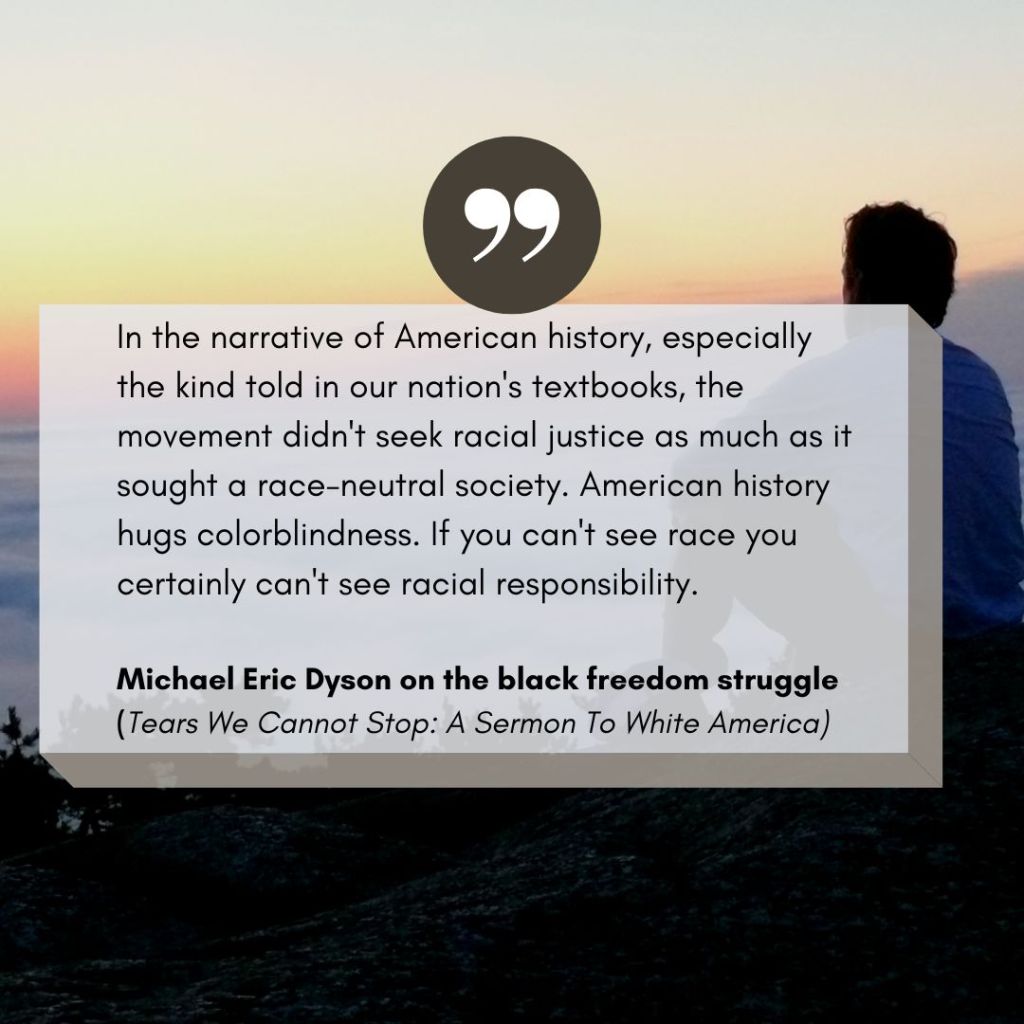
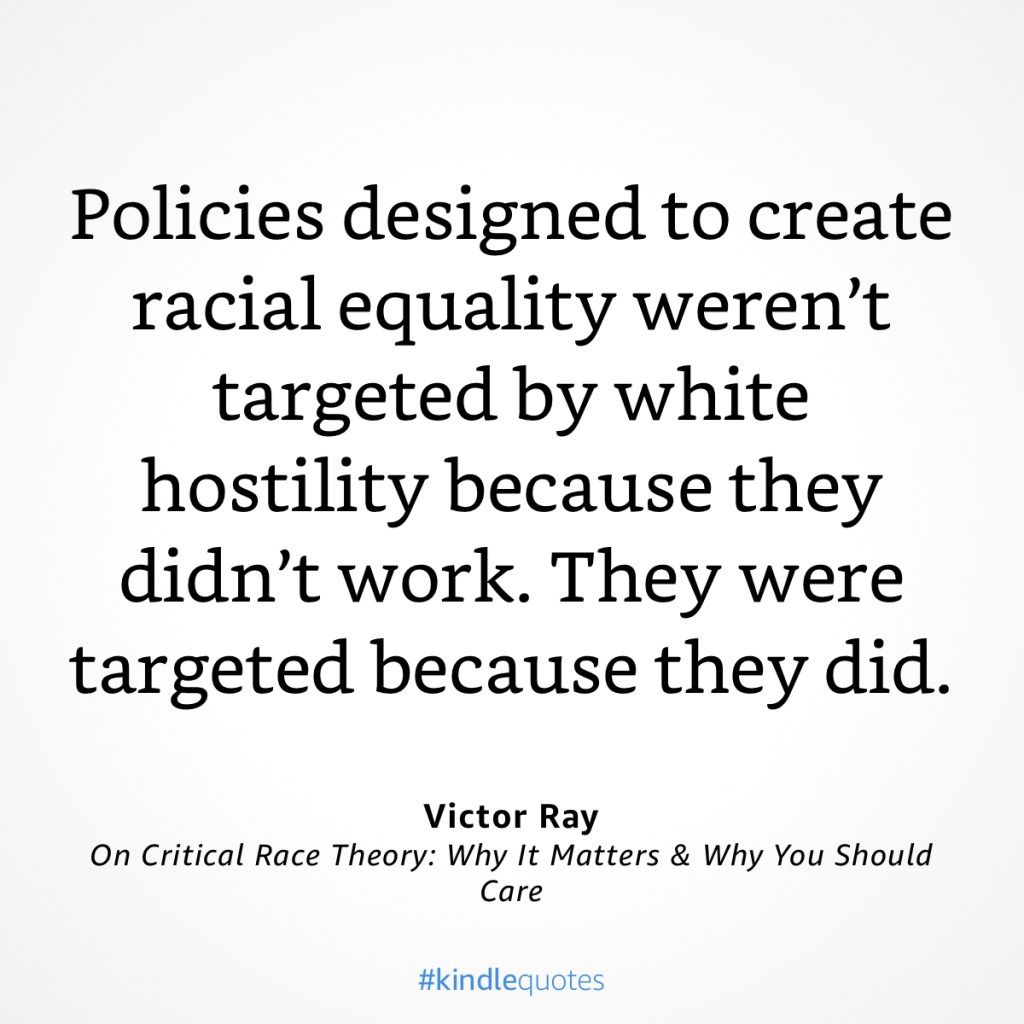
It is hard to understand why the outrage about Critical Race Theory did not quickly subside when the actual architects of the framework had the opportunity to explain its origin and intentions: “to develop laws and policies that can dismantle structural inequities and systemic racism.” (NAACP) Is there another reason that people would intentionally misconstrue the meaning behind this theory or block current students from learning and thinking about it, other than to maintain the status quo? The following quote from Victor Ray certainly resonates here:

To continue to better understand things like CRT that I was never taught in school, I will endeavor to gain a deeper understanding of these “divisive concepts” that some are trying to stop students from learning about. This weekend, Kimberlé Crenshaw appeared on Ali Velshi’s show on MSNBC over the weekend to discuss the controversy over the College Board’s decision to revise its Advanced Placement African American History Curriculum and cut out the following topics:

  • The Movement for Black Lives
  • Institutional Racism
  • Structural Racism
  • Systemic Racism
  • Queer Theory
  • Prison Industrial Complex
  • Mass Incarceration

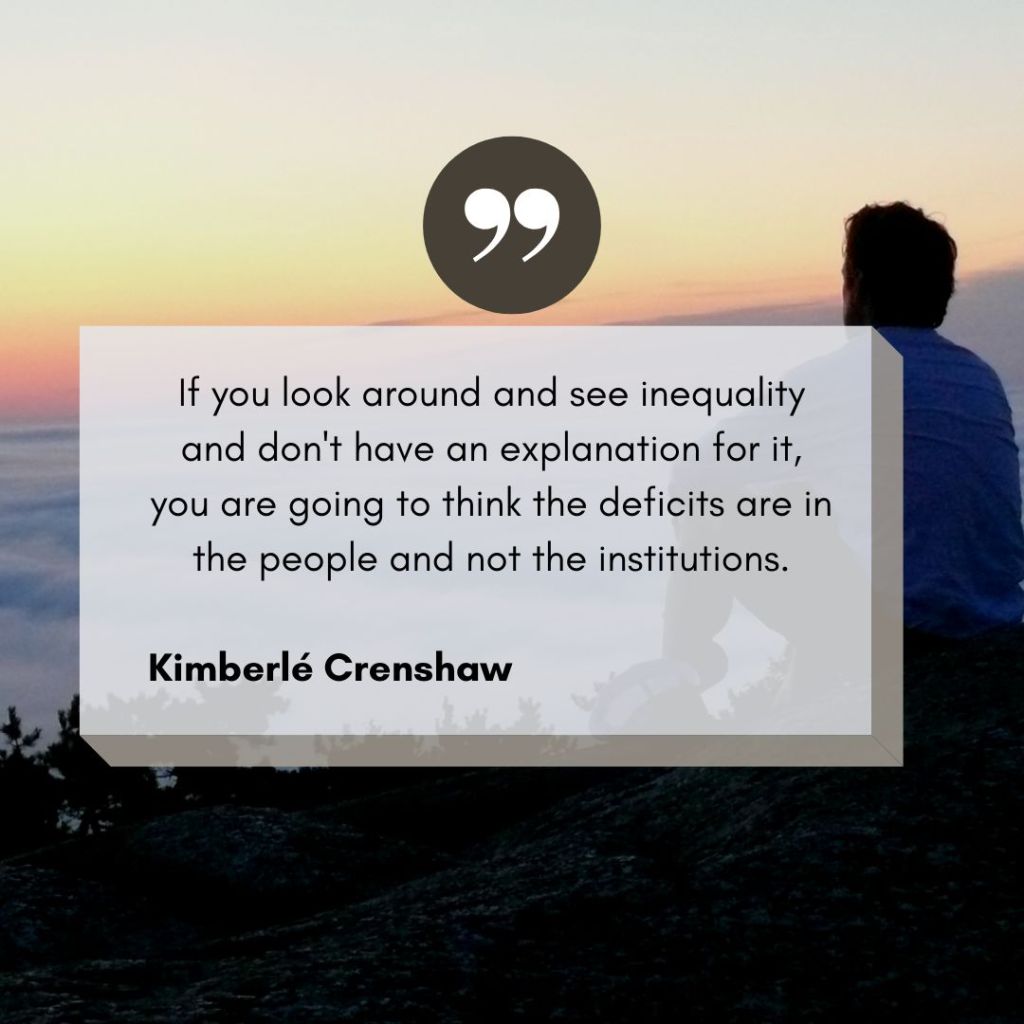
As part of this revision process, the work of Crenshaw, one of the architects of CRT, has been cast aside due to the ongoing misinformation campaign that defines CRT as a theory that is intended to make white kids feel bad about themselves. Crenshaw, a professor at both Columba and the University of California, points out in the interview with Velshi that “Critical Race Theory is not teaching people that they are individually responsible, it’s actually somewhat doing the opposite. It’s saying that these things are the inheritances of structures: structures of the economy, structures of the housing market, and structures of policing.”

Professor Crenshaw goes on to add, “If you look around and see inequality and don’t have an explanation for it, you are going to think the deficits are in the people and not the institutions.”

The entire interview, which is just under nine minutes, is below.

Friday Shares (2-3-23) – College Board’s Predictable Decision

While the news stories continue about the state of Florida pressuring the College Board regarding some of the content of its AP African American Studies curriculum, there are a few things worth highlighting. First, AP courses are elective courses…This means that no one is forced to take them.  Second, the College Board is probably best known for the Scholastic Aptitude Test (SAT) which Carl Brigham, a noted eugenicist, developed. Dr. Tracey Benson, a school leader, researcher, and the co-author of Unconscious Bias in Schools highlights the problematic nature of the College Board offering an AP African American Studies course in his post on medium DeSantis v. Black Studies (2023): New Dog, Old Tricks. He notes, “Ultimately, the pretty package of developing and offering an African American studies AP course represents putting cracked eggs in a flimsy basket.”

If College Board wanted to look anything but disingenuous in this endeavor, they would have had a much more transparent process in the curricular decisions that were made around this course. They could have modeled the type of collaborative process that is necessary when fear-based tactics are used to pressure educators. As Lauren Porosof notes in her ASCD article Navigating Tough Curriculum Conversations, we need to ask ourselves reflective questions like “Is this curriculum making people unsafe or merely uncomfortable? Who, exactly, is uncomfortable? What might be the source of that discomfort.”  Porosof also notes that it is pretty common for adults to “mischaracterize experiences as unsafe when they’re merely uncomfortable.”  

The article concludes with a subheading titled “A Manifestation of Values.” Here’s the first sentence: “Creating curriculum is always a matter of deciding what’s most important for students to know and do, and what anyone considers most important reflects that person’s values.” In this case, it reflects the values of both the College Board and the Governor of Florida. In Florida’s case, there is some irony in the fact that the state is simultaneously moving towards permitless carry of weapons for residents over 21 while at the same time reminding teachers they could face felony charges for unapproved books in their classrooms

Recommended Listen/Watch

Democracy-ish Podcast – New episodes drop each Thursday. Here is the description of the podcast from the Democracy-ish website: “Democracy-ish is a podcast dedicated to fighting for democracy and preserving your sanity in a time when both are under active assault by forces committed to white supremacy and stupidity. For far too long our body politic has been viewed through an all-white prism that does not represent the multiracial nation that is the United States of America. Hosts Danielle Moodie and Wajahat Ali always keep it real, blunt and entertaining as they discuss how we can achieve a multiracial democracy and cover all the ground left behind by mainstream media and seek to make sense out of the nonsense.”

  • Last week’s, Bustin America’s Racist Myths episode featured Princeton History Professor Kevin Kruse who discussed his new book Myth America: Historians Take On the Biggest Legends and Lies About Our Past , a collection of essays by historians which addresses some of the biggest historical inaccuracies about our country. The book includes an essay on Voter Fraud by Carol Anderson, author of New York Times Best Seller White Rage: The Unspoken Truth of Our Racial Divide and Professor of African American History at Emory University, and an essay on Police Violence by Elizabeth Hinton, author of America On Fire and Associate Professor of History in the Department of History and the Department of African American Studies at Yale, with a secondary appointment as Professor of Law at the Law School.
  • This week’s episode, Banning Black History, discusses the College Board’s decision to delete som portions of its AP African American History curriculum after criticism from Florida Governor Ron DeSantis

Recommended Read

A few more articles on the situation with the College Board  

A Framework for Resisting Book Bans – by Daniel Liou and Kelly Deits Cutler in ASCD’s Educational Leadership

This a great article on Resisting Book Bans! The authors share a constructive and proactive framework that ensures diversity, equity, inclusivity, and social justice are prioritized.

4 Ways Anti-Blackness Shows Up In DEI – by Janice Gassam Asare in Forbes

Did you know research done in 2019 found that over 80 percent of Chief Diversity Officers were white? Gassam Asare notes, “Not enough conversation centers around how those of us hired to help eliminate workplace inequities are instrumental in perpetuating harm.”  The four areas she goes in-depth on in the article are: expertise, pay inequity, deprioritizing black issues, and aggregating all non-white employees.

Poll: Parents Don’t Want Schools to Focus on Culture Wars – by Eesha Pendharkar in EdWeek

New data indicates that two-thirds of voters feel culture wars distract schools from their core mission of educating students. Despite this data, the truth is that some states are continuing to pass regulations around “divisive concepts” and banning books that limit access to diverse points of view and cause fear in educators.

U.S. Public Education is Under Attack. It’s Time to Take a Stand – From Lynn Jennings at the Education Trust last February.

The article is as relevant as it was a year ago when Jennings wrote: 

“Education equity advocates and allies must stand united once again, for divided we fall. We must actively resist legislation and state policies that force educators to whitewash U.S. history and deny students the literature that will help Black students see themselves in history and for White students to develop empathy for those who don’t look like them.”

Black Visibility Matters: The Inconvenient Truths of Bias and Erasure – by Kevin Myles of Learning for Justice.

This article is from this past September and Myles’s words about inclusivity certainly resonate this week:

“We must operate in a heightened state of awareness to ensure inclusivity in all realms. Failure to operate on this high frequency means failing ourselves as human beings as we yearn to make the world a better place in which tremendous gifts and opportunities are not wasted because of bias and anti-Blackness.”

Mirrors, Windows, and Sliding Glass Doors – by Rudine Sims Bishop in 1990. 

As some may be aware, Bishop is referred to as the “mother of multicultural literature” for her groundbreaking research in children’s literature. Check out the short video here with Professor Bishop discussing the importance of Mirrors, Windows, and Sliding Glass Doors. 

Additional Resources

ADL’s online bibliography of recommended children’s and young adult books about bias, bullying, diversity and social justice.

ADL’s Monthly Featured Books From This Month back to 2011

UCLA School of Law CRT Forward Tracking Project – The CRT Forward Tracking Project (FTP) identifies, tracks, and analyzes local, state, and federal measures that attempt to restrict access to truthful information about Critical Race Theory (CRT), race, and systemic racism. To demonstrate the breadth of anti-CRT measures across the country, FTP provides a comprehensive database of anti-CRT measures across all levels of government and varying types of official action.

Friday Shares (1-27-23) – When Things Fall Apart

The end of this week came with the video released in Memphis showing five police officers brutally beating a black man, Tyre Nichols, who later died of his injuries. A couple of articles I read as I try to learn more about this man whose life was ended prematurely due to another case of unnecessary violence by police against a black person in this country:

Tyre Nichols’ killing by police — why is this still happening?

Tyre Nichols remembered as beautiful soul with creative eye

Learning for Justice has reposted its resources for Discussing Race, Racism and Police Violence which was first created in 2014.  It outlines how to facilitate conversations with students while also not adding to the trauma black students may be feeling. 

Other relevant reading/listening connections

When Things Fall Apart : Throughline : NPR

This week’s Throughline podcast episode was certainly timely.  The episode noted the following “In the United States, polls indicate that many people believe that law and order is the only thing protecting us from the savagery of our neighbors, that the fundamental nature of humanity is competition and struggle.”

The episode goes onto share the Two Wolves story which is often attributed to the Cherokee: “An old man says to his grandson, there’s a fight going on inside me. It’s a terrible fight between two wolves.  One is evil, angry, greedy, jealous, arrogant and cowardly. The other is good, peaceful, loving, modest, generous, honest and trustworthy. These two wolves are also fighting within you and inside every other person, too. After a moment, the boy asks, which wolf will win? The old man smiles – the one you feed.”

The episode also highlights Veneer Theory, a theory based on the belief that humans are basically selfish and evil and need “civilization” to save them. The episode offers the contrasting points of view of 17th Century philosopher Thomas Hobbes and 18th Century philosopher Jean-Jacques Rousseau. Hobbes was a proponent of a strong government and did not think human beings would be able to refrain from killing each other, or from devolving into a state of mutual destruction without such a government. Author Rebecca Solnit noted the following:

“Hobbes’s idea that somehow you need authoritarian structures to control people corresponds really well to imperialism and colonialism, people who saw themselves as civilization imposing order on chaos.”

Jean-Jacques Rousseau, on the other hand, believed the lives of human beings in the state of nature was actually pretty good. Dutch historian Rutger Bregman summed up Rousseau’s thinking as follows:

“We were quite healthy. We had lots of exercise. We had a varied diet, and it was pretty peaceful as well. But then everything went wrong when we gave up our liberty, and we invented private property, and we settled down in villages and cities, and we created this thing called civilization.”

Ultimately, as we hear the varying narratives about incidents and events where there are various points of view (i.e. the murder of a black man by police), what wolf is being fed? Can we have a full view without knowing our country’s history and without having a good sense of our own identity and privilege?  

Speaking of history

The news out of Florida this week was that Governor DeSantis is looking at limiting what topics we can allow our students to learn about. This article from NPR gets into the discussion about the proposed ban on African American Studies in the Sunshine State. NEA President Becky Pringle summed things up with the following statement:

“When we censor classes and whitewash lesson plans, we harm our students and do them a deep disservice.”

Getting back to the Throughline episode above, what wolf does this narrative feed?

News Literacy is more critical than ever

As I watch some news outlets try to rationalize the killing of Tyre Nichols, I am struck by the irony that this past week The News Literacy Project just completed their fourth annual National News Literacy Week.  This non-partisan organization has amazing resources to help educators guide students (and adults) in being savvier about what they are reading and watching. This probably should have been mandated for all students back in 1987 when the FCC abolished the Fairness Doctrine.  Here is a list of resources for students (and adults) that can help us all better meet the main objective of the News Literacy Project and “determine the credibility of news and other information and to recognize the standards of fact-based journalism to know what to trust, share and act on.”

Concluding this week’s writing with the following reminders that resonated from yesterday’s webinars from the News Literacy Project:

Opinion Journalism should meet the following standards:

  • Credible opinion pieces are based on verified facts and employ sound, logical reasoning.
  • Opinion journalism does not seek to avoid bias or ignore opposing views.

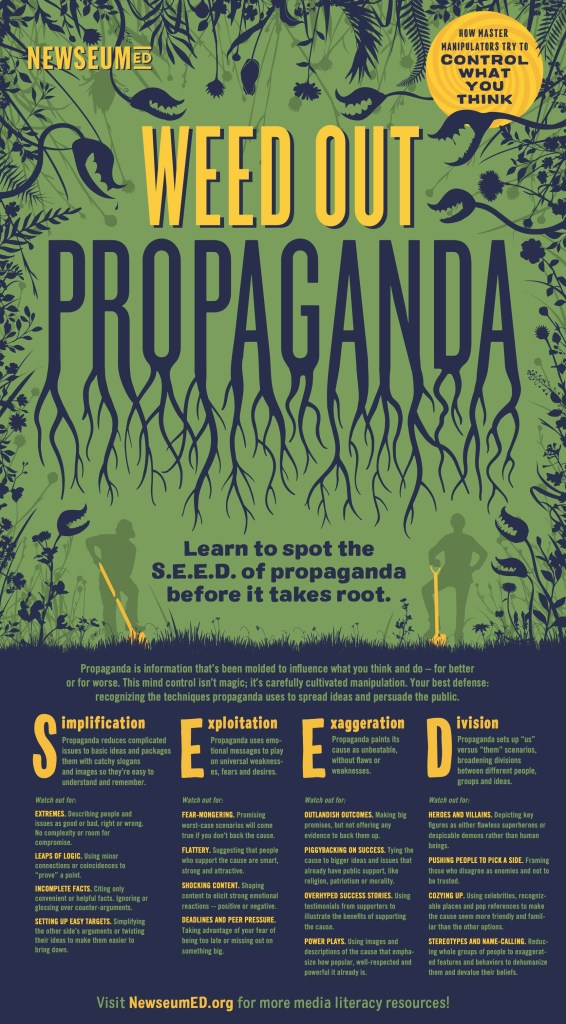
Common Propaganda Techniques

Simplification – Making a complicated idea seem very simple.

Exploration – Manipulating emotions rather than weighing facts.

Exaggeration – Making its cause seem stronger or more popular than it is.

Division – Attempting to broaden and exploit the gap between “us” and “them”

Get the entire poster on Common Propaganda techniques from Newseum.

How can we move past ambivalence in our diversity, equity, inclusion and justice work?

A Boston Globe Article this week highlighted a unique experiential learning program that started in 1971 called Sidetrack. This program was a partnership between the predominantly white suburban community of Lincoln, MA, and the predominantly black urban community of Roxbury. The program was comprised of two classes of 7th graders and each class would have 50 percent of its students from Roxbury and the other 50 percent of the class from Lincoln and the classes would each spend one half of the year in each of the two communities involved. 

Despite the fact that the program showed great promise, the critics won out and the program ended after a year due to a lack of enrollment of Lincoln students. As Peter Thomson, both the author of the article and a student in the program put it, “Sidetrack and its vision would get mired in suburban ambivalence and recede into history.”  He later adds, “The biggest challenge to school integration programs has always been getting white families and communities to buy in.”

What does an unwavering commitment to the work of diversity, equity, inclusion, and justice work look like? I mentioned this last month and shared a t-chart from the San Francisco Coalition of Essential Small Schools on what this unwavering discourse sounds like between educators. I also wonder what this unwavering discourse sounds like and looks like in classrooms and among students, families, and community members…

Friday Shares 1/13/23 and some thoughts on self-compassion

The view from my back porch this afternoon.

I’ve been involved in some great conversations during the past week surrounding self-compassion. As we are early in a new year, many of us set goals and/or make resolutions for ourselves. I wrote last week about trying to be more intentional in making connections and thus using the word connection as my word for 2023. With this in mind it was great to connect with others and discuss self-compassion. An episode of Laura Brewer’s podcast focused on how to practice really helped me make some meaningful connections in my own mind and with others on this idea. 

As an ardent CrossFitter, I made the connection to the importance of muscle memory in regards to improving on so many of the movements we do at the gym. A poor movement pattern repeated over time can result in a plateau or even an injury. When it comes to self-compassion, I can’t help remembering a quote from Dan Harris from 10-percent Happier and ABC News where he said, “The voice in my head is an asshole.” I have tried to drown out this voice by remembering the following words from Brené Brown: “Talk to yourself the way you talk to someone you love.”

Just like a poor physical movement pattern, we can be better with thought patterns and catching the negative voice earlier and finding ways to interrupt that critical voice. Whether it is stopping for a few breaths, going for a walk, or just sitting in the negative feeling and thinking about where it is coming from, all of these are ways that I can try and catch myself and not carry that negative energy into other spaces. This mental muscle memory is also something that I can reinforce and get stronger with. 

Anyway, I hope this resonates for some others. Thanks to Jen B. for sharing Laura Brewer’s podcast with me. I will definitely be diving into past episodes in the weeks ahead. Also thanks to my awesome community members at CrossFit 133 for engaging in the self-compassion conversation!

Recommended listens/watch

Laura Brewer’s How to Make Love podcast – “a podcast designed to grow your love, justice, and courage muscles.”

Leading Equity Podcast with Dr. Sheldon Eakins – As I have mentioned in the past, this is one I do not miss and Dr. Eakins had some more amazing guests since the last Friday Shares:

  • Unpacking the White Innocence Playbook – This episode featured Dr. Melanie Bertrand from the University of Arizona and Dr. Carrie Sampson from Arizona State University. This idea of white innocence actually began in legal studies and Richard Orosco’s has taken this same framework to look at public schooling. The episode highlighted the following 4 discursive strategies of white innocence:
  1. Denying blame
  2. Concealing racism
  3. Dodging responsibility
  4. Glorifying the district

Show Me The Evidence: Culturally Relevant Pedagogy & Primary Sources with Dr. Gloria Ladson-Billings

If you want to learn more about Culturally Relevant Pedagogy, there is no one better than Dr. Ladson-Billings to learn from. This video is from a presentation done back in August for the Minnesota Historical Society. This is one I will watch again, but here are a few of my initial takeaways:

Her thoughts on Critical Race Theory (CRT). “(From the perspective of those decrying it) CRT is everything we don’t like.” Dr. Billings perspective is that “CRT is teaching the truth about our history.”

She describes Culturally Responsive Pedagogy as an equilateral triangle, one where all sides need to be equal. The three sides are composed of Academic Achievement/Student Learning, Cultural Competence, and Socio-political critical consciousness.  She advocates for the use of primary source documents and gives some great examples on how teachers can use them in a culturally relevant way to “make the familiar strange” by asking inquiry-based questions.

Quote I’m Pondering as we celebrate a long weekend in honor of Dr. Martin Luther King Jr.

My One Word For 2023

Happy New Year! Do you have any resolutions for 2023 or new goals? I am not a big resolution person, having failed at so many in the past that I have stayed away from them for a while. Instead, I spent a lot of time thinking about a word that I would focus on for 2023. Being on a sabbatical from my full-time role this year has definitely impacted my word choice as I miss the day-to-day interactions that would be that I was used to working as a public school educator for the past 25-plus years. While the commute to my home office is great and more day-to-day interaction with my wife and our three dogs is great, I miss the multitude of  opportunities to interact with colleagues, students, and community members that I am used to having.

With this in mind, it did not take me long to settle on CONNECTION as my one word for 2023. I see see three main areas where I will be focusing on connection:

  1. Making connections with others 
  2. Making connections with myself
  3. Making connections in my learning

Making connections with others

My most consistent interactions lately are the hour I spend at the gym in the morning and I have noticed I’ve been way more talkative than in the past when I had to head right from the gym to work. In previous years, I was quieter during this hour in preparation for heading to work where the opportunities for connections would be plentiful. One of my goals is to slow down and be more appreciative of the time I have to connect with others in any setting, especially family members.

Making connections with myself

Having a less rigid schedule allows for a much greater focus on both physical and mental health. This time also allows for a great deal of reading, writing, and reflection on what provides meaning. What do I love? I can’t help think of an excerpt in Chapter 10  of Leadership On the Line:

“…love lies at the core of what makes life worth living. Love gives meaning to what you do, whether in a corporation, a community, a classroom, or a family. We take risks for good reason: We hope to make a difference in people’s lives. Leadership enables and challenges us to love well.”

Making connections in my learning

Teaching, taking classes, reading, writing, and reflecting allow me a tremendous amount of time to both learn a lot of new information and to reframe previous thinking. I’ll continue to share some of the things I am reading, watching, and listening to here in this space and hopefully it will help others make some connections as well. As I’ve noted previously, my focus will be on antiracism and equity so that I can continue to grow in my knowledge of the many facets involved in creating schools and spaces where all members feel a sense of belonging.  We can never have deep connections without belonging.

Friday Shares 12/30/22

A quote I am pondering

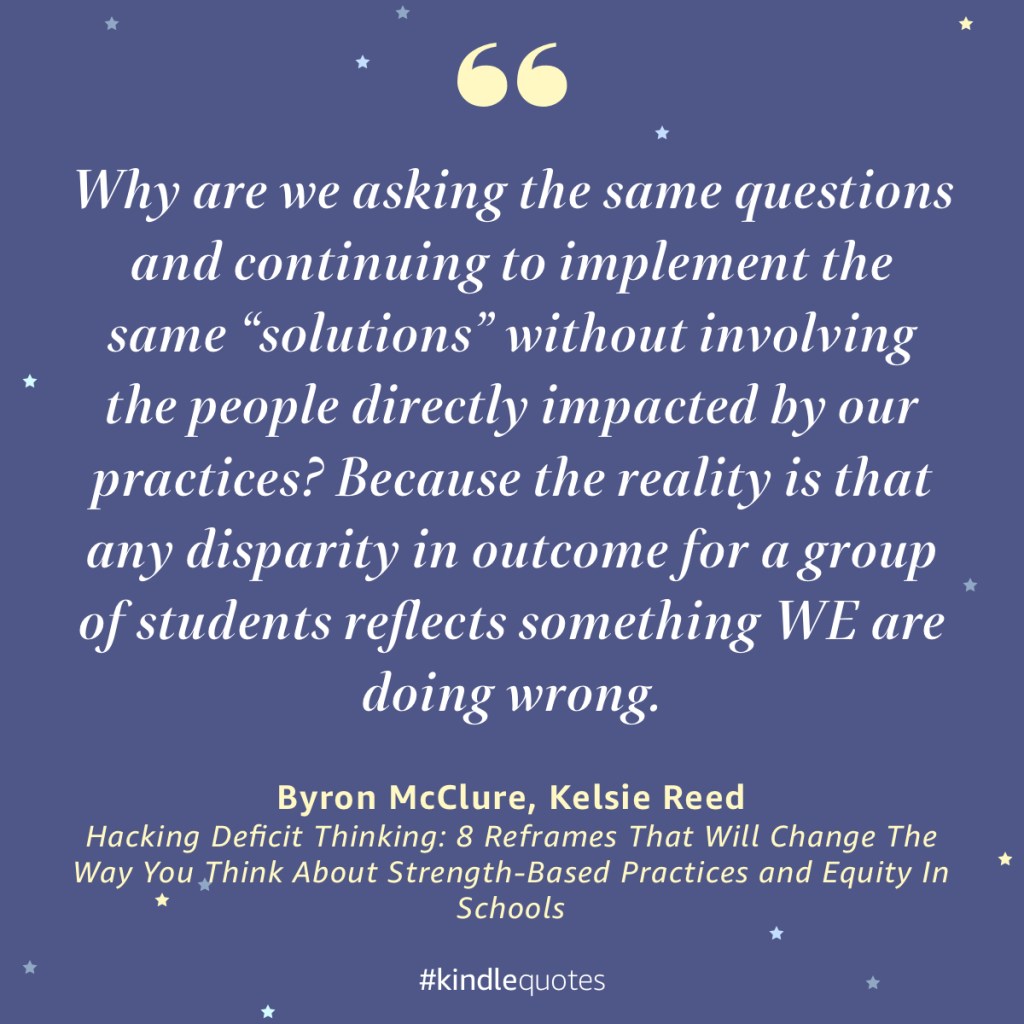
After watching the video on cultural humility referenced below, I cannot help coming back to this quote from Hacking Deficit Thinking.

Recommended listens/watch

The Art of Advocacy with Dr. Sheldon Eakins – The Necessity of Soul Care and Critical Self-Reflection for Equity Centered Educators – I’ve highlighted episodes of Dr. Eakins’ playlist in previous Friday Shares. New episodes of the podcast drop every Monday. Dr. Eakins also has a live stream he does on Thursdays at 6 p.m. called the Art of Advocacy. If you are able to check out the livestreams, you will have a chance to interact with the guests via the YouTube chat feature. If not you can still catch the replays on YouTube. The episode from December 15 featured Dr. Mel. The timing for this episode was perfect as educators head into their December break.  Dr. Mel highlighted the importance of slowing down, self-reflection, and avoiding perfectionism. Dr. Mel also shared a great series on Cultural Humility (see below). Check out the whole episode here and you will see that Dr. Mel definitely lives by her recommendation to “choose joy.” You can learn more about Dr. Mel’s work at Scholars for the Soul.

Cultural Humility – This video from August 2012 is just under 30-minutes. From the description on YouTube: “Cultural Humility is a communal reflection to analyze the root causes of suffering and create a broader, more inclusive view of the world.  Originally developed by Doctors Melanie Tervalon and Jann Murray-Garcia (1998) to address health disparities and institutional inequities in medicine, Cultural Humility is now used in public health, social work, education, and non-profit management.”

The first portion of the video talks about the difference between Cultural Humility and Cultural Competence. A major takeaway from this was the fact that cultural competence often indicates an end point and a checked box, but when we talk about this in relation to learning about other cultures, how could we ever be fully competent. Cultural humility, on the other hand, is an ongoing process. One line that resonated on the topic of cultural humility was: “It is a collaborative investigation that equitably involves those affected by an issue, and is meant to educate and create social change.”  

One other portion that I keep thinking about is an Audre Lorde quote that ties into the vulnerability that goes along with humility – “The fact that we are here and that I speak these words is an attempt to break that silence and bridge some of those differences between us, for it is not difference which immobilizes us, but silence. And there are so many silences to be broken.”

Time for Teachership Podcast – Beyond “Performative Partnership” with Afrika Afeni Mills

This episode of the Teachership podcast is from January 2021 and Dr. Lindsay Lyons talks with Afrika Afeni Mills, who is the Director of Diversity, Equity, and Inclusion for BetterLesson, and an Education Consultantabout, about moving beyond performative work to enact partnerships that can create real change in our schools and communities that result in more equitable schools and classrooms. Ms. Mills 

Cult of Pedagogy Podcast – How to Build Psychological Safety in Professional Development

This episode of the Cult of Pedagogy podcast with Jennifer Gonzalez features Bright Morning’s Elana Aguilar in a discussion on how to provide a space where psychological safety is prioritized for Professional Development. As Aguilar notes in the episode, “Learning requires us to be vulnerable and yet facilitators often don’t create the psychological safety, the conditions in which we can be vulnerable, take risks and say, I don’t know.” The episode goes on to highlight the portion of a The PD Book from Aguilar and Lori Cohen which focuses on the ways we can build an environment for Professional Development that allows educators to feel psychologically safe so they can fully engage in the learning experience. The podcast shares 5 Ways to Build Psychological Safety for Teachers from chapter two of the book and the strategies that Aguilar uses for adult learning spaces are equally important for setting up successful learning spaces for students. Aguilar notes the following: “Safe is the minimal required condition for learning.” The thought by the facilitator and the collaborative processes needed are described in great detail. Check out this episode and The PD Book which I discussed back in November

Speaking of Bright Morning and Elana Aguilar, check out her episode from this week on setting yourself up for success in 2023. Elana shares some tips on helping to become more reflective and gets into it a bit deeper on the Bright Morning Instagram account

That’s it for this week. Happy New Year! Wishing everyone a 2023 that is full of joy both personally and professionally!

Are We Really Living Our Equity Values In Our Schools?

“Racism is a system we all live within. As a result, many common ideas that we perceive as “normal” or “traditional” are actually racist ideas.”

Henry Turner and Kathy Lopes from Changing the Narrative: How to Foster an Antiracist Culture in Your School

There are two brief texts that I have been reading and re-reading over the last week. One is a new article from hthunboxed titled Swimming Against the Current: Resisting White Dominant Culture in Improvement Work by Amanda J Meyer. The second, from 1997, is a chapter from Race, Ethnicity, and Multiculturalism Policy and Practice titled Changing the Discourse in Schools by Eugene Eubanks, Ralph Parish, and Dianne Smith

One of the questions Meyers asks in her piece is “What if, instead of focusing on the equity practices we think we should be adding to our improvement repertoire, we also considered what forces may be pulling us away from living our equity values in everyday practice?”

This connects well to the second text “Changing the Discourse in schools.” The authors note “the current dominant discourse in schools (how people talk about, think about and plan the work of schools and the questions that get asked regarding reform or change) is a hegemonic cultural discourse. The consequence of this discourse is to maintain existing schooling practices and results. We call this hegemonic discourse, Discourse I.”

The needed alternative is Discourse II which the authors describe as follows:

“In a Discourse II school, ambiguity and change are part of a purposeful structure. The direction for change is clear. It is intended to produce schools where every student develops intellectually to high levels and the performance gap related to race, class and gender narrows until school effects are no longer correlated with those factors.”

Both pieces have resources connected to them that school groups working for substantive change in their antiracism and equity efforts could utilize. Meyer provides a table which provides a clear delineation between harmful patterns that are often perpetuated in improvement by characteristics of white dominant culture and “moves to resist and imagine” these characteristics. 

The resource connected to the chapter on Discourse I and Discourse II is a T-Chart created by the San Francisco Coalition of Essential Small Schools which has concrete examples on one side of Discourse I “dialogue supports and maintains the status quo without appearing unresponsive to outside demands for improvement.” Directly across are examples of Discourse II “the language that tends to be about uncomfortable, unequal, ineffective, prejudicial conditions and relationships in schools (and therefore) opens up space for ambiguity and change to be part of a purposeful structure.” It would be a powerful exercise for school teams to use the T-Chart to describe how Discourse I sounds in their context and to flip the script to Discourse II.

Friday Shares 12/16/22

One of the positives of being on sabbatical this year is having the time to do more reading, writing, listening, and reflecting on how we can ensure more inclusive school communities where ALL members feel welcome and have a sense of belonging. We cannot create these communities without talking about systemic inequities (i.e. systemic racism) and creating actions to dismantle these systemic inequities.

As part of this writing and reflective process, I want to share some of the great books, videos, podcast episodes, and social media posts I am finding that can benefit others who share the same commitment to this critical work.  As a white man who has been oblivious to instances of interpersonal racism, institutional racism and systemic racism for the majority of my life due to my implicit bias, I have perpetuated harm to BIPOC members of communities in which I have worked. Everything I share, is part of my Unlearning Journey to do better…

I am also posting my reflections on substack and am looking to do a bit more writing in that space, so if you are interested, check it out at patricklarkin.substack.com/.

Recommended listens

Dr. Sheldon Eakins Leading Equity podcast

This week – LE 274: An Approach to Anti-Racist Teaching and Leadership with Dr. Tracey Benson  – In this episode Dr. Eakins speaks with Dr. Tracey Benson, an educator, author, and consultant for schools looking to eliminate racial gaps and racial bias.  Dr. Benson is the co-author of Unconscious Bias in Schools, which I cannot recommend more highly.  At the beginning of the podcast, Dr. Benson explains how he sees Antiracism work and Diversity, Equity, and Inclusion (DEI) work as two very different things. “If you read a book and hope for the best or bring in (a speaker) and hope for the best under the guise of DEI, but never identify that structural racism or interpersonal racism is even at play then we depart from the philosophy that DEI has anything to do with addressing racism”

Two quotes from Unconscious Bias in Schools that resonate here are ‘We value truth over comfort” and “Don’t think that a few technical steps will eliminate the danger you pose to the kids you care about.” 

Pink Card 30 for 30 Podcast – The following is a brief summary from this series on the ESPN website – Pink Card follows three generations of Iranian women who risk their lives for the simple right to watch a soccer game. It will forever change how you view fandom and freedom. It may help a greater understanding of the Iranian Mens’ Soccer team’s decision to not sing their national anthem prior to their opening match of the World Cup.  

Recommended reads

Stop Punishing Poverty in Schools – Paul Gorski in ASCD

This article kicks off with a quote that hit home:

“Inclusion is a commodity. Belonging is, too. Many students are priced out of it at school.”  

Gorski goes on to identify a stop doing list of four ways we can help address the disadvantages faced by economically marginalized students:

  1. (Stop) Marking Students as Deficient

We can do this by asking the following questions:

“What are barriers, inequities, and biases people experiencing poverty face?” “How are we perpetuating them?” “What can we do differently to distribute access equitably?”

  1. (Stop) Treating Kids Equally, and Therefore, Inequitably

“Be alert to temptations to slide back to equality, to redefine fairness around that concept, when equity efforts raise the ire of families accustomed to enjoying the benefits of disparate access. In my experience, the most vehement advocates for “equality” tend to be people bent on sustaining their children’s advantage.”

  1. (Stop) Humiliating Children Through Everyday Practices

Find ways to raise money that don’t require students to compete over whose families and neighbors can afford the most chocolate bars or wrapping paper. If we’re going to host book fairs, let’s structure them around the joy of reading, not the sale of books and trinkets.

  1. Pricing Them Out of Learning

The key is not to pick one or two obvious instances of inequity and imagine our work is done when we’ve solved them. We can dig deeper, mapping out all the ways this sort of inequity operates so we can address its root causes and adopt more equitable policies and practices.

Gorski ends the article with an exercise in Mapping Costs for Learning, Joining, and Belonging at Your School. 

Decarceration Begins With School Discipline Reform – Anthony Conright – Learning for Justice – Fall 2022

This article from the fall issue of Learning for Justice talks about the importance of prioritizing trauma-informed and restorative practices over a punitive response. Conright highlights the following:

“Trauma-informed and restorative justice practices are among the beginning models of an equity process to disrupt the school-to-prison pipeline. And while systemic change is essential, educators have an immediate responsibility to prioritize the mental health and well-being of students.”

Despite The Best Intentions

I mentioned this book in my last Friday Shares on 12/2/22 after hearing the interview with the authors John Diamond and Amanda Lewison the Teaching While White Podcast and the book definitely lived up to its expectations. This book would be a great book for school administrators to read as a leadership team, a whole staff, or a community-wide read. Riverview is a portrait of too many schools in this country. 

There are so many quotes that resonate Here are a couple:

“Disciplinary routines communicate key messages to students about who is and is not a full citizen in the school context.”

“White students report navigating the hallways freely and not having their intentions questioned, both unearned advantages of whiteness.” 

Reading The Bible From The Margins 

This recommendation from a friend intrigued me and emphasized the importance of considering the context of any book from the standpoint of who is doing the writing and what their identity and lived experiences have been. The author, Miguel A. De La Torre, notes the following in the book which was first published in 2002:

“I believe in the Bible and approach it with reverence, searching its pages for the grace of God needed to achieve liberating salvation from both individual and societal sins. Yet, I do not necessarily hold the same reverence for human interpretations, especially interpretations that arise from a privileged dominant culture that justifies a status quo that normalizes oppressive race, gender, and class structures.”

“Rather than confess the inequalities of society are due to racist social structures, religion (as well as other communal networks) provides psychological reassurance of legitimacy; in other words it confirms that the wealth, power and privilege amassed by the dominant culture are theirs by right.”

“Only interpretations that empower all elements of humanity, offering abundant life in the here-now, as opposed to just the here-after, are biblically sound.”

So You Want To Talk About Race

Ijeoma Oluo’s book from 2018 is one that I am revisiting. In chapter one, Is It Really About Race, Oluo highlights three simple guidelines to decide if something is about race:

  1. It is about race if a person of color thinks it is about race.
  2. It is about race if it disproportionately affects people of color.
  3. It is about race if it fits into a broader pattern of events that disproportionately or differently affect people of color.

From Chapter four, Why am I always being told to “check my privilege”?:

“Try to remember that the alternative to not being made aware of your privilege (no matter how it may sting) is your continued participation in the oppression of others.”