Amanda Ripley’s Intriguing Talk On Education Reform

I came across the video above from Amanda Ripley’s talk at Pop Tech 2012 on Scott McLeod’s Blog.  It really is something that I would recommend for anyone who is concerned about the state of our schools.

Ripley who is well known for her first book, The Unthinkable: Who Survives When Disaster Strikes — and Why, is working on a book due out this summer titled The Smartest Kids In The World. In writing this book, Ripley took a unique path to investigating how the countries ranked ahead of the United States on the PISA test educate their students. She interviewed some top American students who spent time as exchange students in some of these countries and asked them to compare their experiences abroad with their experiences back here stateside in American classrooms.

The video concludes with the following three takeaways from these conversations:

  1. In the top performing countries in the world school is harder.  
  2. No country is like the US with its obsession of playing sports. 
  3. Kids (in schools in these other countries) believe there’s something in it for them. 
  4. Kids believe that what they are doing in school impacts their futures.

Ripley ends with these words , “If we want to know how to raise resilient kids, there are lots of ways to find out. One of the ways to do this is to ask kids because kids can tell you things that no one else can.”

I am excited for the book! In the meantime, I’ve added Amanda’s blog to my RSS feed.

Going 1:1? How Would You Respond To Comments Like This?

Also posted on the Connected Principals Blog:

I had the opportunity to appear on National Public Radio’s Here and Now Program last week along with one of our students to talk about our 1:1 iPad program here in Burlington at our high school. The segment was titled Educator Answers Your Questions On iPads In The Classroom While the interview went well, I really enjoyed reading the comments from listeners who choose to enter their feedback.  Our first appearance last March resulted in 122 comments and while this year’s appearance prompted a bit less feedback, I think it is important for people who pursue these types of initiatives to be ready to respond to comments like the one below.

For about three thousand years or more all that was needed  for learning and writing was some sort of pencil. Plato never wrote his master piece The Republic on an iPAD. Leonardo Di Vinci never used and iPAD. Giuseppe Tomasi di Lampedusa did not use an iPAD to write his Sicilian masterpiece The Leopard and Hemingway never wrote A Farewell To Arms with on a iPAD. Pencil and paper are a thousand times cheaper, yet we continue to spend my tax money on iPADs which don’t seem to improve learning, or on car race tracks as part of the Fiscal Mythical Myth phony deal which produced a modicum for revenue to pay down deficits. Apparently if a young person at school does not have access to an iPAD he or she can’t learn! The simple process of using pencil and paper is good for students. This simple process exercises and induces the brain growth plus coordination of other areas of a young persons developing body including learning how to write. So what does a young person really for a quality foundation to learn? He or she needs a grownup at home to help them with their after school home work. To many households in America have two people working and are to tired to help their children with their homework. Really, this is just a slick promotion for selling Apple products (which are quit good) which in turn make money for investors and does not guarantee success in the class room.

While there are a number of predictable questions that you will need to answer in regards to WHY you support such a financially significant initiative, the one above is one that is common from taxpayers who don’t want to spend the money necessary to put modern resources in the hands of teachers and students.   I know I did not respond to all of the arguments that were made and I am not even saying that my comments were “the right answer.”  The point is that schools and/or individuals entering into this type of an endeavor need to be prepared to provide a response that they are comfortable with. Of course, the best part is that we have a growing number of schools creating concrete evidence of what can happen when these initiatives are implemented thoughtfully.
As I conclude with my response below, I am wondering how others would respond to this type of comment?

I agree with some of what you say, but the point is that none of the creators of classic work that you mentioned had the opportunity to use technology like an iPad.  While I have no problem with pencil and paper or someone who prefers to get a task done with those tools, I think we have to face the fact that the world has changed and that the jobs that our students will be working in will probably not be employing paper and pencils. Learning happens and it happens in many more ways than what you and I were programmed to think in our traditional experiences.

 Having said this, I think that the role of public education is to prepare students for the real world. The fact of the matter is that the people outside of our schools, in the real world, are using these tools more and more. My doctor walks into the exam room with an iPad in his hand and the pilot who flew the last plane I traveled on also utilized an iPad in lieu of his old flight manual. 

Whether we like it or not, I think that the our students need experiences utilizing modern resources like tablets or whatever comes next. While I do not think technology can be used to do everything (i.e. DaVinci’s masterpieces), I am pretty sure these great minds woud have taken advantage of modern technology. In fact, I am thinking that Plato would have been much happier with a pencil that had an eraser instead of something along the lines of a metal stylus that was probably in his hands at the time.  

 In regards to the change that has occurred with families in our world today, I do not think we can blame technology for that. My belief is that we can utilize some of the technologies we have available to keep families connected in a time when so many more factors keep them apart. While nothing can replace the physical presence of a family member or loved one, we need to be thankful that we have ways to stay connected when we can’t all be together in the same place.

That reminds me, I need to facetime my son to see how his day went at school today. It’s so much better than a text or phone call. I am thinking Alexander Graham Bell would approve?!

BPS Back on NPR’s Here and Now Show On Our iPad Initiative

I was accompanied by BHS senior Sidd Chhayani a few weeks back on a trip into Boston’s NPR radio station WBUR to appear on the show Here and Now with Robin Young to discuss our iPad initiative after year one. We did an initial interview last year and learned it was the most popular segment from last year’s programs. 

You can hear the entire interview above.  There was also a live webchat today on the show’s webpage where listeners were able to take part and ask questions. Thanks to Here and Now for the opportunity to talk about our efforts in Burlington!

A Question I Hope To Ask More In 2013 – Who Is Doing The Teaching?

139f63a5-e1c3-4250-9823-40c938d8e15b

It doesn’t seem like that long ago when the number of administrators (and educators for that matter) sharing their stories online was scarce.  Aside from the excitement of seeing our numbers grow over the last couple of years, I continue to be energized by the potential we have to improve our schools as increasing numbers of educators share what is happening in their classrooms, schools, and communities.  Allowing others to see concrete examples of progressive ideas being implemented successfully gives others the confidence that they are not out on a limb by themselves when they consider taking similar risks.

While I am grateful to be part of a community of educators that pushes my thinking daily, there is a group out there that influences me even more, our students.   In fact, I’ll tell you that the question on  the picture above (Who is doing the teaching?) is really a trick question. The real question that we need to ask ourselves is who is doing the learning?  Or better yet, as individuals, we need to consider whether we are continuous learners ourselves.

Personally, I am constantly looking at my own daily routine and thinking about whether or not I am practicing what I preach. Am I spending too much reading, blogging, tweeting, etc?   Am I just consuming details about the efforts of others?  What am I contributing myself?

The moments that tend to impact me most are opportunities to learn with others (in-person).  I feel fortunate to be in a district where there are formal and informal opportunities to learn with and from both students and staff. In looking ahead to 2013, I hope to see the line between teachers and learners continue to blur in our schools. I hope to see more public examples of this to share within and beyond our school community.

Here are a few of my favorites from 2012!

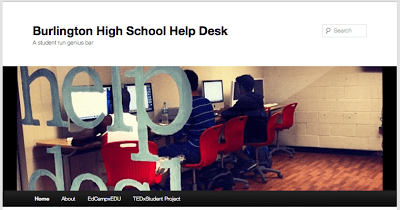
#1 Burlington High School Student Help Desk Website

#2 Marshall Simonds Middle School Students PSA On “The R Word”

#3 Learning Every Day in Burlington – Features a daily post from a learner in our school community. 

A New Blog From Richard Byrne…Focused On iPad Apps!

Richard Byrne’s Free Technolog For Teachers Blog has been one of the top resources for educators trying to integrate technology into their classrooms for quite some time.  In fact Richard’s blog was again selected as the Best EdTech Blog in this year’s Edublog awards. What makes Richard’s blog so useful is the fact that he reviews all of the resources that he posts and also has a number of publications and videos that can help teachers in their efforts to utilize more digital resources.

Well, Richard has added to his web-presence with the creation of a new blog geared towards educators looking to implement iPads in their classrooms.  At the beginning of December, Richard started a new blog called iPad Apps for School.  I have already made it a must follow and added it to my RSS feed.

Thanks for the early Christmas present Richard!

Here are a few recent posts from the new blog worth checking out:

10 Great Apps for a Teacher’s New iPad

An Augmented Reality Math Game
MeeGenius Puts Great Children’s Stories on iPads
Maily for iPad Gives Students a Safe Place to Learn to Email

Enhanced by Zemanta

"It’s Just A Christmas Ribbon"

photo-1

When my first-grader asked me about the ribbon on my jacket yesterday afternoon, I was not sure exactly what to say. A few thoughts zoomed through my head as I settled on my response which was, “It’s just a Christmas ribbon.”

While I feel a sense of relief that my six-year old doesn’t understand the nature of the events that occurred in Newtown, CT a week ago today, the reality is that what the ribbon symbolizes most to me is the precious gift that we have in our nation’s children.  As a parent of an elementary student, I have been riding the wave of emotions that so many of us have experienced in the last week.  I am continually amazed at so many of her qualities, ones that she shares with her elementary-aged peers, qualities like happiness, resilience, and innocence just to name a few.

The fallout from the events last week have impacted so many of us due to the fact that we lost 20 little ones in such a a violent and unfathomable way. As a nation, we are struggling to gain back our feelings of happiness, resilience and innocence. But while things will never be the same, I pray that time will allow us to overcome our new fears for our children so that we can be united in our unending efforts to ensure that our students our emotionally and physically safe.

There are just too many levels to this conversation for a quick and easy solution. But when I look down at the ribbon on my jacket today, my initial thoughts of this national tragedy have moved from anger to acceptance. The initial horrific pictures in my head have moved on to more positive visions. These are visions of an amazingly resilient community who has come together to support one another in the worst of times.  They are stories of strength and forgiveness from those who have been affected the most.

So what I could not say to Mary Clare is this:

The ribbon is a symbol of a community that has gone through a horrific tragedy and in dealing with these events the people of this community have shown an entire nation inconceivable resilience.  It is so much more than “just a Christmas ribbon…”

7 Reasons iPads Rule?

English: iPads offer a variety of software
English: iPads offer a variety of software (Photo credit: Wikipedia)


Some impressive facts from ign.com on the impact of iPads:
  • Over 100 million sold 
  • iPad sales topped all other PC Manufacturers in the second quarter of 2012
  • 94 percent of Fortune 500 companies use iPads “in an official capacity.”
Despite these mind-blowing numbers, I am always interested in the discussion of what device is best in an educational setting.  Audrey Watters wrote a post this week asking, “Why Tablets?” that got me thinking about this a bit more, especially given the fact that we currently have over 1,200 iPads in Burlington, a number that will soon be over 2,000 as we deploy iPads at the middle school level.
Audrey wrote the following about iPads:

 I was struck once again by the abundance of hype over tablets. I confess, I just can’t do the work I need to do on an iPad, but I don’t want to suggest that that means they’re useless for others. It does make me wonder about what I’m missing by being a skeptic, as well as what students are missing when we give them tablets and not (my preference) laptops.

While I love the iPad myself, I too find myself utilizing my laptop first in many cases.  I feel quite guilty sometimes by the fact that I can pull out my MacBook Air to accomplish many tasks while students only have an iPad to access.   While I have tried at certain points to put away my laptop and get through my day with the same device that our students have, I have not been successful in doing this for more than a day.

Thinking back to our 1:1 planning meetings, I remember our main issues were cost, battery-life, and ease of use.   We looked at laptops and minis for a while and then the iPad hit the market it quickly moved to the top of the list (since we could not afford MacBooks for everyone).  Of I wondered if we were just buying the shiny new toy that the novelty would wear off quickly.

While we certainly did buy the shiny new toy and yes the novelty has warn off a bit, our satisfaction with our choice has lessened little.  The main reason is that for even the most techno-phobic user the iPad could not be easier to utilize.  There is no complicated operating system to deal with or software to learn. The ease-of-use allows us to focus our time and energy on the numerous resources that we now have at our fingertips. Instead of training on the device, we are spending our time referencing our learning goals and pulling in from the plethora of resources that allow us to reach them in new and engaging ways.

In regard to the list of reasons that iPads rules, I really don’t have a list of reasons.  Honestly, it’s up to learners to find out which tools/resources work best for them.  Make your own list! It’s a lot more fun than using someone else’s! 

Enhanced by Zemanta

Breaking News! No More Homework! (In France)

image via ristinaskybox.blogspot.com

In case you missed it French President Francois Hollande has vowed to eliminate homework for student in France as part of some sweeping education reforms he is proposing to lift France from its poor education ranking among countries in Europe.  President Hollande was quoted as follows on his desire to eliminate homework in the New York Daily News:

“An education program is, by definition, a societal program. Work should be done at school, rather than at home.”  

It will be interesting to see if the elimination of homework in France happens and how it impacts student learning.  I cannot help wondering what would be lost if we eliminated homework across the board in American schools. I think Ryan Bretag’s great post, Two Questions about Homework, gets right to the heart of this issue.

 Here are the two questions Ryan asks:

  1. As a whole, would “achievement” drop if homework didn’t exist?
  2. As a whole, would the joy of learning, living, & schooling increase if homework didn’t exist?

While the answer to the second question seems obvious, I would encourage classroom practitioners to give number one a try and find out for themselves.

Enhanced by Zemanta

Do Schools And Educators Take Too Much Blame For Failed Reform Efforts?

As someone who is passionate about school improvement, I was very interested in a post this morning by Valerie Strauss in her Washington Post column (The Answer Sheet).  The post, titled Why almost all school reform efforts have failed, highlights the findings of David C. Berliner of Arizona State University in a new essay entitled Effects of Inequality and Poverty vs. Teachers and Schooling on America’s Youth just published in the Teachers College Record at Columbia University.

The basic premise of the essay is that the problems in our nation’s schools are due more to economic and social policy than to education policy.  Having said this, there are clear examples of a shortsighted education agenda as well, but it is clear that many of our education outcomes are a result of the impoverished conditions impacting many students. Despite the fact that we have tremendous work to do in improving the our educational system nationally, we need to stop targeting poor teaching and inadequate schools as the primary issue that will resolve our country’s poor ranking on global measures such as The Program for International Student Assessment (PISA).  


While I encourage those interested in schools and school reform to read the entire essay, I have taken the liberty of citing (in italics) some of the excerpts that I found most interesting below.  

This paper arises out of frustration with the results of school reforms carried out over the past few decades. These efforts have failed. They need to be abandoned. In their place must come recognition that income inequality causes many social problems, including problems associated with education. Sadly, compared to all other wealthy nations, the USA has the largest income gap between its wealthy and its poor citizens.

Thus it is argued that the design of better economic and social policies can do more to improve our schools than continued work on educational policy independent of such concerns.

A question we all need to ask! 

The research question asked is why so many school reform efforts have produced so little improvement in American schools.


 The problem with blaming teachers and schools for all of our country’s ills… 

What does it take to get politicians and the general public to abandon misleading ideas, such as,“Anyone who tries can pull themselves up by the bootstraps,” or that “Teachers are the most important factor in determining the achievement of our youth”?

But the general case is that poor people stay poor and that teachers and schools serving impoverished youth do not often succeed in changing the life chances for their students. 

America’s dirty little secret is that a large majority of poor kids attending schools that serve the poor are not going to have successful lives

Most children born into the lower social classes will not make it out of that class, even when exposed to heroic educatorsA simple statistic illustrates this point: In an age where college degrees are important for determining success in life, only 9% of low-income children will obtain those degrees (Bailey & Dynarski, 2011).

Because of our tendency to expect individuals to overcome their own handicaps, and teachers to save the poor from stressful lives, we design social policies that are sure to fail since they are not based on reality.  

The problems with our national Education Reform efforts 

It may well be that the gains now seen are less than those occurring before the NCLB act was put into place. In fact, the prestigious and non-political National Research Council (2011) says clearly that the NCLB policy is a failure, and all the authors of chapters in a recently edited book offering alternative policies to NCLB reached the same conclusion (Timar and Maxwell-Jolly, 2012). Moreover, a plethora of negative side effects associated with high-stakes testing are now well documented (Nichols and Berliner, 2007; Ravitch, 2010).

Nations with high-stakes testing have generally gone down in scores from 2000 to 2003, and then again by 2006. Finland, on the other hand, which has no high-stakes testing, and an accountability system that relies on teacher judgment and school level professionalism much more than tests, has shown growth over these three PISA administrations (Sahlberg, 2011).

Still, most state legislatures, departments of education, and the federal congress cling to the belief that if only we can get the assessment program right, we will fix what ails America’s schools. They will not give up their belief in what is now acknowledged by the vast majority of educators and parents to be a failed policy. 

The Finland Phenomenon is also more about social policy than education policy 

Although we are constantly benchmarking American school performance against the Finns, we might be better served by benchmarking our school policies and social programs against theirs. For example, Finland’s social policies result in a rate of children in poverty (those living in families whose income is less than 50% of median income in the nation) that is estimated at well under 5%. In the USA that rate is estimated at well over 20%!

Virtually every scholar of teaching and schooling knows that when the variance in student scores on achievement tests is examined along with the many potential factors that may have contributed to those test scores, school effects account for about 20% of the variation in achievement test scores, and teachers are only a part of that constellation of variables associated with “school.”

On the other hand, out-of-school variables account for about 60% of the variance that can be accounted for in student achievement. 

What is it that keeps politicians and others now castigating teachers and public schools from acknowledging this simple social science fact, a fact that is not in dispute: Outside-of-school factors are three times more powerful in affecting student achievement than are the inside-the-school factors (Berliner, 2009)?

Berliner goes on to cite a number of possible policy changes that we could implement to do change the course of our failed education reform efforts. Again, I encourage you to read the entire essay.

Enhanced by Zemanta