From the Burlington Planning Board – Medical Marijuana Meeting This Wednesday

You’re Invited to….
A Meeting with the Planning Board to Discuss
Medical Marijuana in Burlington
Burlington must adopt a new bylaw to regulate the production and sale of medical marijuana in town. 
Please come and share your opinions with the Planning Board as they prepare a Warrant Article for May 2014 Town Meeting.
Wednesday, February 12, 2014
7 pm to 9 pm
Burlington High School
School Committee Room
All are welcome. Bring your friends and neighbors, but please leave the kids at home!

My Weekly Diigo Bookmarks (February 9, 2014)

Image representing Diigo as depicted in CrunchBase
Image via CrunchBase

In an attempt to reflect back upon the numerous blogs and articles that I peruse online each week, I have decided to autopost the items that I bookmark on Diigo each week. Below are all of the links that I compiled last week in my Diigo account, with a few of my favorites highlighted in more detail at the top.

Posted from Diigo. The rest of my favorite links are here.

My Weekly Diigo Bookmarks (February 2, 2014)

Image representing Diigo as depicted in CrunchBase
Image via CrunchBase

In an attempt to reflect back upon the numerous blogs and articles that I peruse online each week, I have decided to autopost the items that I bookmark on Diigo each week. Below are all of the links that I compiled last week in my Diigo account, with a few of my favorites highlighted in more detail at the top.

Posted from Diigo. The rest of my favorite links are here.

Sharing a Conversation About Introverts

As I think about a couple of the teenagers in my life and the typical struggles that they face regarding who they are and what makes them so special, I wonder how much they struggle with the public perception that people who are quiet and/or sometimes detached are somehow inferior.  Do they know it is okay (and normal) to withdraw sometimes? Do they feel it would be some type of social stigma if they or someone else classified them as introverts? 
Today, I was fortunate to talk to a proud introvert about this topic and when she told me that Susan Cain’s book (Quiet) changed her life. She told me that prior to reading Cain’s book, she always had a feeling that there was something wrong with her. Our conversation then took a turn towards the classroom and the fact that there is such a big push for collaborative/cooperative learning in many classrooms and that this type of learning can be torture for introverts.
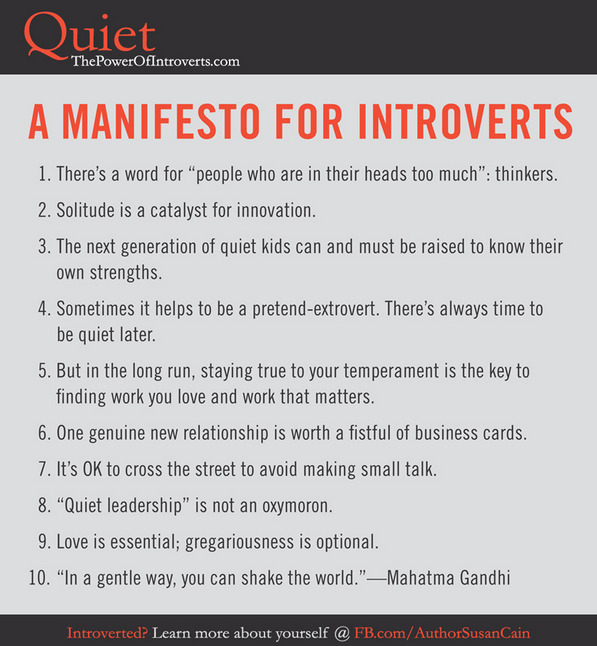
The reality here is that I could write endlessly and never articulate the issues as concretely and articulately as Cain does. If this is something that interests you, please check out the manifesto above and the video below (which has over two million views).  If you feel like it, share something that strikes you from your own personal experience in the comment section below. 
For example, number seven on the manifesto (“It’s OK to cross the street to avoid making small talk”) hits home for me on a couple of levels. First of all, I have been guilty of this behavior at various times. Secondly, I have been with people who have been offended when others have avoided them or walked by with their heads down in a crowd even though it was obvious that they were avoiding them. In this case, many people jump to the conclusion that the offending party is a snob or has a problem with them. While that could be the case, I would contend that it is much more likely that the other person is simply an introvert…

//www.youtube-nocookie.com/embed/c0KYU2j0TM4

A Typical Day At Pine Glen

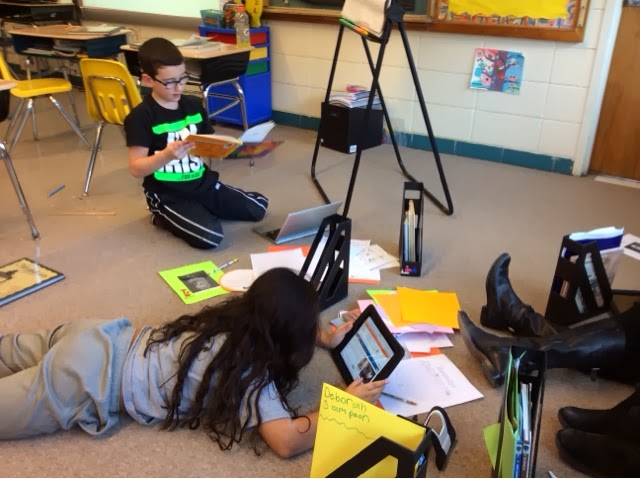
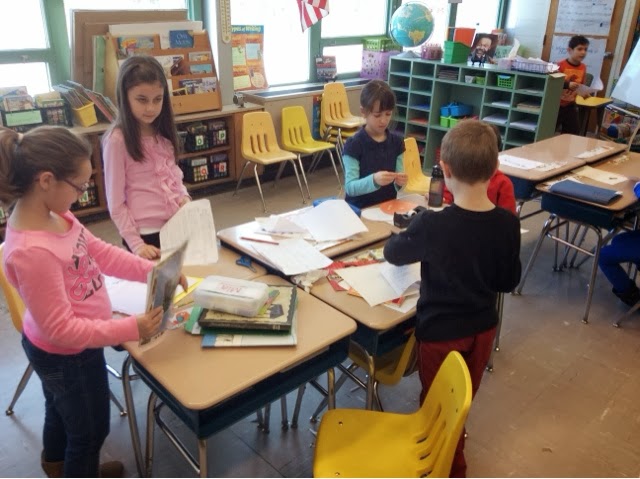
Today I had the privilege of filling in for Mr. Lyons at Pine Glen. As is normally the case, there were too many fun things happening to keep up.  Below are a few of the pictures from my time in various classrooms. Thanks to the staff and students for being so welcoming and taking the time to fill me in on all of the exciting learning activities that they are involved in. I look forward to filling in again on Friday, February 7!
When I arrived in Ms. Hayes’ classroom, she and her students were on a train ride through New Hampshire.   
The second graders are involved in a research project on famous people from Massachusetts. It was great to talk to them and hear how much they know about their historical figures.  A couple of the girls told me that they are excited to make a visit to Oxford, MA to see Clara Barton’s House. I am impressed with how excited and committed these students are about their research.  I am excited to see visit their wax museum at the end of February when each student will take on the persona of their historical figure.
It was neat to see the different methods students utilized to go about their work. Some with iPads, some with Chromebooks, and some with pencil and paper.
More research from Mrs. Lynch’s class.

They were also working hard in Mrs. Cunha’s room.
Mrs. Cunha’s class doing their research.


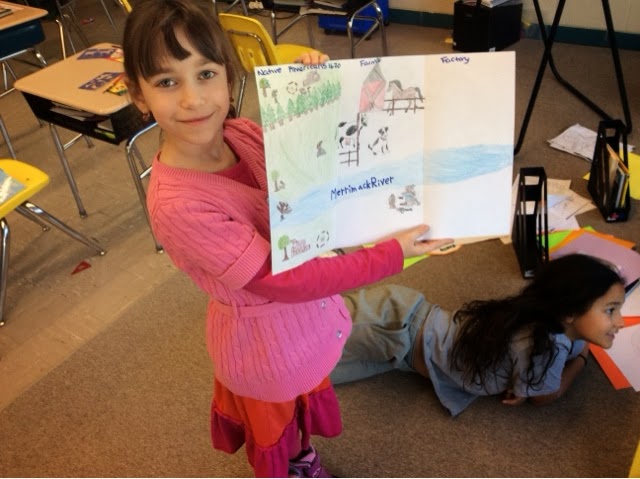
Some great art work of the banks of the Merrimack River through history.

#Rhizo14 Week Two – Enforcing Independence

My second post for the open course that I am participating in called Rhizomatic Learning that is being offered through Peer-to-Peer University (P2PU).  The course is being facilitated by Dave Cormier, Manager of Web Communications and Innovation at the University of Prince Edward Island.

I absolutely love this week’s theme of Enforcing Independence! The oxymoronic nature of the theme is clear like so many of the other contradictions we see daily in the world of education. However, it is equally clear that one of our primary goals in schools is (or should be) to help students develop the skills to be independent learners. In order to help support students in the development of these skills, we need to ensure that the educators in our schools have learning experiences where choice and learning with others are the norm and not the exception.

As someone who has a significant voice in the Professional Development offerings in my district, I spend a lot of time thinking about how to provide educators in our district with a greater degree of flexibility in leading their own learning.  While we have had fleeting success with some learner-led days, we have not developed a formal structure where educators are able to create individualized plans that are flexible based on their needs.

Thinking about what our students need to be prepared for a world where things are changing at a speed that is sometimes incomprehensible makes it clear that our educational model needs an overhaul. We are educating our children and attempting to equip them with the skills that will allow them to be able to compete for a jobs that have yet to be created. The problem for me (and I’m guessing other who were educated in a traditional setting) is that I sometimes lack the vision for what is possible.  My own experiences as a learner are a severe impediment to my thinking when it comes to preparing meaningful learning opportunities for staff members.

I agree with Dave’s description of what the end result will be if we are successful in designing learning opportunities for our staff members:

“People need to self-assess and self-remediate. They need to be able to say that they don’t understand something and then be able to figure it out. There is no freedom until people can do this(unfortunately) we have crushed it out of our education system.”

With this in mind, I have been reading a lot about the professional learning of adults and I have seen some models which I think could help give us a start on the right path. Shelly Blake-Plock was spot on in his post last month regarding PD fore teachers:

“The point of professional development shouldn’t be in having teachers check off a box that they attended a session or watched a video or took on a project. And it surely shouldn’t be in having an administrator check off a box for them. The point of professional development should be in helping human beings–who in this case happen to be educators–become more fully engaged and connected with their peers and fellow professionals. The goal should be helping them to develop the profession themselves.”

One of the more concrete examples of this comes from Albermarle, VA where the district is making teachers the architects of their own learning.   Their Seven Pathways to Ensuring Life Long Learning Capacities for Every Child is a great model for other school communities to employ to ensure a greater degree of independence for learners.  As we plan our PD opportunities for next year, I look forward to the challenge of providing our staff with these types of learning experiences.

Related articles

Enhanced by Zemanta

My Weekly Diigo Bookmarks (January 26, 2014)

Image representing Diigo as depicted in CrunchBase
Image via CrunchBase

In an attempt to reflect back upon the numerous blogs and articles that I peruse online each week, I have decided to autopost the items that I bookmark on Diigo each week. Below are all of the links that I compiled last week in my Diigo account, with a few of my favorites highlighted in more detail at the top.

  • Posted from Diigo. The rest of my favorite links are here.
Enhanced by Zemanta

Must Watch Video: The Amazing Sam Berns

I came across this TED Talk by Sam Berns today as I was scrolling through my RSS feed.  Sam is an amazing young man from Foxboro, MA who passed away earlier this month from Progeria  at the age of 17.

The video below was from a TED Talk Sam did back in October. The title for Sam’s Talk was “My philosophy for a happy life.” You simply need to take 13 minutes to watch Sam’s words of wisdom and then share them with someone else.   (I’ve added another clip of Sam below from his HBO film Life According to Sam).
//www.youtube-nocookie.com/embed/36m1o-tM05g

//www.youtube-nocookie.com/embed/zy1khIdgcyc

Enhanced by Zemanta

#Rhizo14 Week One – Cheating as Learning or Cheating our Learners?

I’ve decided to jump into an open course just starting called Rhizomatic Learning that is being offered through Peer-to-Peer University (P2PU).  Thanks to Lyn Hilt for blogging about the course earlier in the week in her first #Rhizo14 post Skirt the Rules.  The course is being facilitated by Dave Cormier, Manager of Web Communications and Innovation at the University of Prince Edward Island.
The description of the course is what drew me in because it sounded so different from anything I have experienced in any course I have ever participated in. Here’s a bit from the description on the P2PU course page that piqued my interest:

“Rhizomatic learning is a story of how we can learn in a world of abundance – abundance of perspective, of information and of connection. A paper/location based learning model forces us to make decisions, in advance, about what it is important for students to learn…What happens if we let that go? What happens when we approach a learning experience and we don’t know what we are going to learn? Where each student can learn something a little bit different – together?” 

Week One Post 

The topic for the first week of the course is “Cheating as Learning.” I used tube chop to grab the clip below from the week one video on Community as Curriculum where Dave talks about how he takes the idea of cheating out of his classroom by creating a problem that is complex enough to force his students to have to work together in order to find a solution.

I have gotten into discussions about cheating before and I know how passionate people can be about this being a very cut and dry issue where there is no room for interpretation. However, I cannot help thinking that we can do a much better job in setting the stage (like Dave) where students are tackling authentic problems that create situations where they need to work collaboratively. 

“In school, looking at someone else’s paper to get the right answer is forbidden.  But in the work world, the people who rise the fastest are the ones who know the right person to ask to get the answer.”  Penelope Trunk

While I am not here to argue about the merits of someone copying an answer from someone else’s paper, I do wonder about an assessment that calls for someone to regurgitate factual information. I think we need to reflect upon the types of assessments that we are administering and eliminate those that require rote memorization of inane facts. I firmly believe that if this is the primary method for us to chart the progress of our students, then we are the ones cheating. We are cheating our students of valuable time that could be used for more significant learning activities that would help prepare them to be true collaborators.

In closing assignment one, I can’t help thinking back to Tony Wagner’s book The Global Achievement Gap and his Seven Survival Skills (below) that our students need whether they are going on to college or the workplace. How many of these skills would be best developed alone?  

  1. critical thinking/problem solving
  2. collaboration/leading by influence
  3. agility and adaptability
  4. initiative and entrepreneurialism
  5. effective oral and written communication
  6. accessing and analyzing information
  7. curiosity and imagination
Enhanced by Zemanta

My Weekly Diigo Bookmarks (January 19, 2014)

In an attempt to reflect back upon the numerous blogs and articles that I peruse online each week, I have decided to autopost the items that I bookmark on Diigo each week. Below are all of the links that I compiled last week in my Diigo account, with a few highlighted in more detail at the top.

Posted from Diigo. The rest of my favorite links are here.