Top Post #4 – Is The iPad King? It Is For Us And That’s All That Matters (For Now)

(This post originally ran in January.)

BHS students on their iPads

I have seen a few posts lately on the topic of which device is the best device for a school looking to go 1:1 and put a web-enabled device in the hands of each student.  One that caught my attention yesterday was  5 Reasons The iPad Will Stay King Of The Classroom which was posted on Edudemic.

The Edudemic post, written by Adam Webster, notes that the iPad has the following advantage over a laptop:

“The iPad, its workflow and its apps, allow for real change and makes it easy. Your students will create work that not only wasn’t possible before their innovative use of the technology, but that you as their teacher had never even thought of.”

From my own experience in year two of an iPad 1:1 program here in Burlington, I agree wholeheartedly that the newness of this device and the necessity of creating new work flows leads to more innovative uses than we would see from a laptop.  However, this can only happen in schools and classrooms where students are allowed flexibility that is not common in many traditional classrooms.

My point is that neither the iPad nor any other new gadget or gizmo will allow students the type of discoveries that Adam describes in his post unless it is coupled with a mindset that is still atypical in most schools. This change I am talking about is one that does not lead students in step-by-step processes to complete the most rudimentary task, instead it is a learning environment where students have clear outcomes to achieve, but are left with many ways to achieve these outcomes.

So I guess I continue to worry about schools that gobble up iPads (or any other digital device) thinking that it alone will have a transformational effect on learning.  Greg Kuloweic made the point very well in answer to the question “Why iPad?” on the EdTechTecher Site.

“Fundamentally, I believe that an iPad can neither be good or bad. All it can ever be is an iPad. I argue instead, that when used effectively and with specific goals in mind, iPads can have a positive impact on education.” 

So after a long lead in to reiterating the fact that people change schools, not devices, I am at my second and larger concern.  This one revolves around our ability and the ability of our students to think outside of the platform that we have chosen.  Personally, I love Apple devices and have a an iPhone, iPad and MacBook to prove it. However, when it comes to the iPad, I do worry about creating a school full of iOS “app-dependent” students and staff. I worry that our choice of platform will limit the thinking of our students down the road and box them in.

Adrianna
Adrianna (Photo credit: patricklarkin1967)

While I believe that we have made the best decision for our school today, things change quickly and we need to create organizational and individual flexibility to adapt to these changes when they occur.  So for the immediate future I  believe we are on the right path, but there is no discounting the fact that there are forks in the road that we will need to anticipate.  No King rules forever…

Enhanced by Zemanta

Top Posts #3 – 5 Ways For Teachers To Get Quality PD This Summer

This post first appeared on Edudemic and is post #3 in my reposting of my top five posts from the past school year – Enjoy!

1. Attend (or start) a summer Edcamp

For the third consecutive summer, our district will host an Edcamp each Tuesday morning in Burlington, MA. These informal sessions are open to educators from Burlington and beyond who feel like gathering to lead their own learning. Attendees assemble each week and decide what topics will be the focal point for their learning. We provide members of our Instructional Technology staff (including our high school students) to support those looking to expand their skills with technology integration. In addition, teachers from Burlington can earn in-service credits or Professional Development Points for their attendance.
This model could be replicated anywhere! All you need to do is pick some dates, provide a space, and invite local educators. Trust me – if you plan it, they will come.

2. Attend A Multiple-Day Workshop

Most of the teachers whom I know hate taking one day off from their classroom during the school year, and they would never consider missing consecutive days for a workshop of any kind. The amount of additional advanced planning, combined with the time away from their students, is just too much for these folks to bear! Well, there is no time better than the summer months to escape the guilt of missing a day of school and treat yourself to a quality learning opportunity with educators and taught by other educators. Check out the summer-long list of workshops offered by EdTech Teacher’s staff of classroom practitioners.

3. Massive Open Online Courses (MOOC)

The beauty of a Massive Open Online Course (MOOC) is that most of the learning opportunities can be done regardless of time and place. You can choose what you learn, when you learn, and where you learn. If you are anywhere with a wireless signal, and you want to try the MOOC experience, then your only dilemma is choosing from the extensive list of options out there.  A great place to begin your search is at www.mooc.ca, a comprehensive list of MOOC’s maintained by Stephen Downes.
If you are looking for a less intimidating option, you could also enlist a group of colleagues and run through the some of the topics from the educational-technology focused #ETMOOC which ran between January and March of this year. The important part here is to find a space where passionate educators can find a topic of common interest and share their learning journey regardless of space or time.

4. Participate in a Weekly Twitter Chat

If you are an educator, then there is a Twitter chat for you. Check out this awesome Google Spreadsheet of Twitter chats broken down by nights of the week that was created by@thomascmurray and @cevans5095.  There are literally chats for every grade level and discipline that you could imagine. My suggestion would be to speak to your district or building administrator about earning credits towards recertification for your participation (in MA we call these credits Professional Development Points). You could use storify to archive your participation in the chats and incorporate your tweets into a reflective blog post to provide documentation of your learning.
If you need help getting started with Twitter, check out Erin Klein’s great video that appeared on Edudemic last week.

5. Just Hang Out

If you haven’t experienced the capabilities in a Google+ Hangout, you are missing out! Check out the schedule of Education On Air sessions that is available to educators for free learning opportunities. Educators could also create their own hangouts for colleagues to discuss a pertinent topic, collaborate on curriculum work, or even do a book discussion. The possibilities are literally endless, and the hangouts allow you to record the sessions to have for future reference. At the very least, I encourage you to try a hangout with one or two friends to see how easy it is to set up and utilize the numerous built-in functions.
Given all of the avenues available for professional development, 2013 could be the best summer ever! What a great time to take advantage of these opportunities to advance your own learning!

Enhanced by Zemanta

Following #ISTE13 From A Distance – Thank Goodness for Hashtags!

I first noticed the power of following a conference hashtag two summers ago during the Building Learning Communities Conference in Boston. While I was unable to attend the event due to a number of schedule conflicts, I was amazed at the number of resources that I was able to access by following the tweets of the attendees during the conference.  With this in mind, I decided that I would spend some time going over the stream of tweets from ISTE’s Annual Conference to try to fill some of the void that I am feeling from missing out on the biggest Ed Tech conference on the planet.

As I began to look through the Twitter stream on the #ISTE13 hashtag and save some of the more interesting links to my Diigo bookmarks, it struck me that I should be sharing them here as well. I am sure I missed a number of great resources trying to follow the action in San Antonio from so far away, but here are a few that piqued my interest.

Leading Innovative Change – Google Doc from presentation by George Couros (Thanks to @wfryer for tweeting it!)

Changing Our Vocabulary As Technology Integration Coaches
This post from Wes Fryer reinforced the point “that non-techy terms are important when we want to win the hearts and minds of parents as well as other teachers.” Check out the great list of alternatives that Wes gives to help schools make this transition.

10 Killer iPad Projects Students Will Love #ISTE13 – from Sandy Kendell (AKA EdTech Sandy), an EdTech Specialist in Texas.


The Persistent Appeal of Technology in Learning – from Edutopia


Free Resources for Better Content Creation – from Horry County Schools in South Carolina

Stay tuned for more…

Enhanced by Zemanta

Top Posts #2 – An Uplifting Video (Created By A 16-Year Old)

The post below originally ran on January 1, 2013 with the uplifting video which was created by 16-year old Sophia Pink, the daughter of author Daniel Pink. As I watched again last night, I thought it was a perfect blog post (and video) to share one again as we come to the last day of school in Burlington.


As my last post of 2012 mentioned, I love sharing work created by students with others.  I am amazed on a daily basis by the thoughtfulness and insights that students have to offer and I feel so fortunate to be an educator in a day and age where it is so easy to share these examples with others in our school community and beyond.

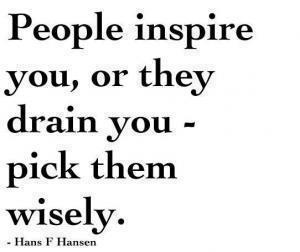
With our students off on vacation for the past week, there really hasn’t been anything new to share from our students, but I did come across an uplifting video that was created by a 16-year old in Washington D.C.  Thanks to Daniel Pink for sharing the impressive work of his daughter Sophia on his blog today!   It is a perfect video to watch as we begin a new calendar year and we consider the types of people and environments that can inspire us.

As I leave you with a favorite quote of mine below, I hope that you all feel the urge to honk often in 2013!

Enhanced by Zemanta

Top Posts #1 – How Necessary Is Homework?

As we enter the final week of our 2013-2014 school year, I thought it would be neat to look at the most popular posts from my blog this year. The post below was written back in September and the topic was homework. Enjoy!

Photo via http://survivorpediatrics.wordpress.com/

John Spencer has started a conversation around homework on his blog Education Rethink.  He has written a post titled A Week Without Homework Challenge  where he is asking educators and parents to rethink the assigning of homework for one week.  He has also started an open Facebook Page where parents and teachers can have a running dialogue on this topic.

Here’s an excerpt from his post:

I’ve written before about my belief that homework is far more destructive than constructive. I don’t think it increases learning, adds to motivation or develops a strong work ethic. For a long time, I assigned homework out of a sense that I was “supposed to.” I never questioned it as a practice. After getting rid of it, I remained quiet on the topic. After watching my sons lose necessary playtime and learning time to do extra-duty schoolwork (mostly packets), I grew more vocal.

I have to say after watching my own kids do homework during the first few weeks of school I share John’s sentiments. As I watched my 7th grade daughter try over and over to get all of the countries in Europe plugged into the right spots on an interactive map and a achieve a success rate of 85-percent, my frustration continued to grow.  It was past her bedtime as she tried to achieve the success rate her teacher had required for the sixth or seventh time.

As I sat watching her grow more frustrated with her assignment, I was sure that I would be equally unsuccessful had I been asked to complete the same task. Despite my success as a student at the high school and college level and the attainment of an advanced degree, I feel like my inability to recall the exact location of each of the countries in Europe has not had a negative impact on me.  Therefore, I am left to wonder what my daughter could have been doing with this timeframe of more than an hour that would have been a more meaningful learning experience.  The possibilities are certainly endless…

We have had very limited conversations about this topic in Burlington since the showing of Race to Nowhere last year.  In fact the Race to Nowhere team has written a letter for the National PTA asking the group to challenge schools to rethink the assigning of homework.  I know this is an issue that needs to be discussed more in the district where my children go to school and I think it would be beneficial to have a similar discussion here.

Related articles

Enhanced by Zemanta

Field Day Fun For Everyone!

Memorial School Field Day 2013

As we creep ever closer to our summer vacation,  our elementary schools are holding their annual field days. The picture above may be my favorite one as a couple of the adults get into the spirit of spraying each other with water.  Check out Memorial custodian Bob Ganley and third grade teacher Lauren Kippenberger in a show down.

You can see the rest of my pictures from the Memorial Field Day here. 

The Social Media Dilemma

For me, social media is learning media. My main use of tools like Twitter, Facebook, Google+, Pinterest is to find and share resources on the topics about which I am most passionate. These resources have allowed me to interact and learn with people from all over the globe. The most significant example of this for me was my involvement with the start of the Connected Principals Blog thanks to connecting with George Couros, an administrator from Alberta, Canada. George came up with the idea of creating a space for administrators to share their learning, and after connecting the conversations with a Twitter hashtag (#cpchat), I instantly became part of a constantly expanding group of thoughtful school leaders. Frankly, I think that those who are adamant that these resources should not be utilized by learners do not understand them. Clay Shirky describes this phenomenon in his book Cognitive Surplus:

“When you see people acting in ways that you don’t understand, you may ask rhetorically, Why are they behaving that way? A better question is this: Is their behavior rewarding a desire for autonomy or competence? Is it rewarding their desire to feel connected or generous? If the answer to any of those questions is yes, you may have your explanation. If the answer to more than one of those questions is yes, then you probably do.”

With this in mind, it is imperative that any guidelines for social media use start with the positive presupposition that these resources add tremendous value for learners. We need to help policy makers see the positive outcomes that these tools can support and not just the worst case scenario. The only way to do this is to provide support for adults to learn how social media can add value to their lives while at the same time reinforcing the countless positive examples of their use that have enabled both individuals, and entire countries, to create a more promising future. So while there are huge ramifications that many colleges and employers are now asking applicants to sign a social media release in order to investigate the applicants social media accounts, schools need to step forward and support students in this area and not create policies that prohibit access for fear of the worst-case scenario.

Historically, it has been the role of schools to help students to start to build their resume and portfolio in order to market themselves to the college or employer of their choice. We need to embrace the fact that social media accounts are now part of that application package that we are responsible for guiding our students to create. My EdTechTeacher colleagues, Beth and Shawn, wrote a great post on this back in the fall titled From Smoke Signals To Tweets: How The Evolution Of Communication Is Changing Your Classroom. It is clear that there are a lot of variables here that need to be hashed out in regards to creating a comfort level for school communities to embrace the use of social media. I’ll address some of these specifics in my next post – Moving Beyond Banning.

Enhanced by Zemanta

A Four Minute Video On The 2013 K-12 Horizon Report

The New Media Consortium (NMC) has just released its fifth Horizon Report for K-12 education. As it has done in each of the previous four years, the report “examines emerging technologies for their potential impact on and use in teaching, learning, and creative inquiry within the environment of pre-college education.” (via NMC.org)

The video above is a short synopsis of this year’s report highlighting the six technologies to watch in 2013. The technologies cited are –

  1. Cloud computing
  2. Mobile learning
  3. Learning anayltics
  4. Open content
  5. 3D Printing
  6. Virtual and remote labs

The video also explains the three adoption horizons:

  1. near-term (12 months)
  2. mid-term (2-3 years)
  3. far-term (4-5 years)

The report is a great guide for schools to see where they stand in regards to staying current with technology planning. You can get the entire report here.

Enhanced by Zemanta

Homework, Always A Hot Topic…

Homework
photo via http://www.flickr.com/photos/71443419@N00/6221553242/

As we approach the end of the school year, I have been looking back at some of the topics I have written about this year. One of the most popular topics (which I wrote about back in September) was homework

Interestingly, I have also seen a few good posts on homework over the last week.
Last week Kristen Swanson posted The Great Homework Debate. She summed up the conversation quite nicely as follows:

“Homework is only a tool. It’s how we use (or misuse) homework that makes the difference. The three questions below can be helpful guides to determine if your homework is a force for good or evil:

AUTHENTIC: Would a student be required to do this task on personal time in real life?  

All homework assignments should be authentic, or related to the requirements of real life. Some professions, such as general dentistry, don’t require any “take-home” work. However, orthodontists, architects, and editors have quite a bit of “take-home” work. Consider the professions related to the task you’re assigning. Would this task be done on personal time? If so, go ahead and assign it. If not, think twice. Be sure to communicate these connections to students; it will help them make more informed choices about their careers!

DELIBERATE: Does this task encourage students to engage in deliberate practice? 

Deliberate practice requires you to design tasks that require specific and sustained efforts on individual areas of weakness. Have you identified a particular student’s weakness and targeted it through the assignment of the task? If so, go ahead and assign it. If your homework is monolithic and one-size-fits-all, then think twice.

ENGAGING: Would YOU be excited to complete this task?

Completing 50 rote math problems that look exactly the same doesn’t exactly inspire passion. Defining an arbitrary list of words doesn’t correlate with a love of reading and writing. Put simply, would you have the forbearance to complete the task you’ve just assigned? If not, don’t expect your students to be enthralled either! (Check out Nick Provenzano’s attempt to complete all the homework he assigned to students HERE.)

If your homework is authentic, deliberate, and engaging, then it’s likely a worthy tool within the educational program you’ve designed for students. Extending learning in safe, meaningful ways can help students accelerate their progress.”

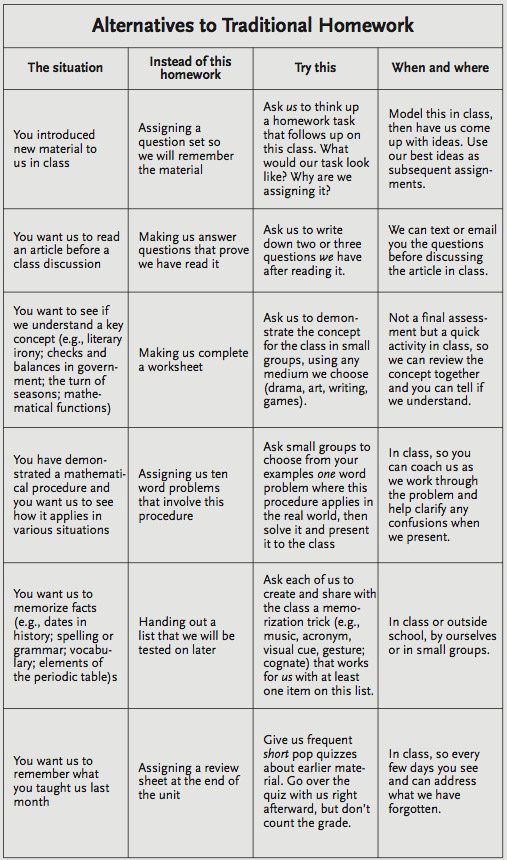
Today, I came across Alternatives To Homework: A Chart For Teachers on Teach Thought.  Check out the chart below.

Enhanced by Zemanta