How I (Try To) Keep Up With BPS

I often get asked about the advantages of social media for educators and how we use these tools in Burlington Public Schools. While our district is not as large as many with just six schools and about 3,500 students, I can’t imagine being able to keep up with all of the activities and news in our district without these tools.

Through our district hashtag #bpschat, my RSS feed in Feedly, and various Google Alerts, here’s what I learned about last week:

Mrs. Burns’ Fifth Graders at Memorial participated in The Global Read Aloud

Mrs. Burns’ fifth graders read The Fourteenth Goldfish by Jennifer Holm as part of the annual Global Read Aloud. The culminating event of this worldwide effort where students from around the globe read a common book is a live chat with the author on YouTube. Check out the clip below where our BPS students had one of their questions answered by the author!

http://swf.tubechop.com/tubechop.swf?vurl=iguW_zo16I4&start=790&end=832&cid=4195107

Student Field Trips

Staff shared some great photos of our students as they extended their learning outside of Burlington.

BHS Help Desk student – Cat Hoyt’s video 

BHS Help Desk Student Cat Hoyt submitted the video below for the CSTA Faces of Computing Contest. 


Spirit Week at BHS

//storify.com/patrickmlarkin3/field-trip-pics-from-week-of-november/embed?border=false

BHS Social Studies Teacher (Michael Milton) Presents at National Conference

BHS Social Studies Teacher Michael Milton (on the right in the picture below) presented at the National Council of Social Studies Teachers’ Conference in Boston on Friday. You can read more about it on the BHS Social Studies Department’s Blog.

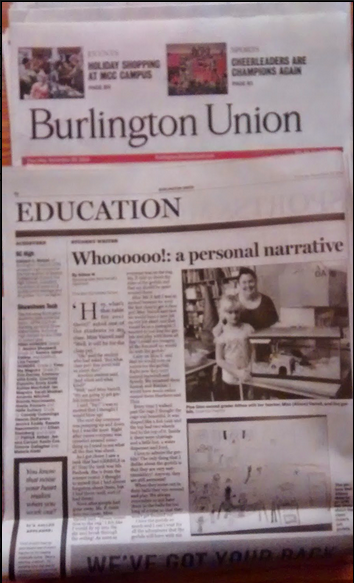
One of Miss Varrell’s second graders was published in the Burlington Union

Our second graders have been working on writing personal narratives and one of them even had their writing published in the Burlington Union last week. Congratulations to Miss Varrell and her student, Althea, on this exciting news!

iPad Apps for School Is a Must Follow Site – Burlington Blog Update (Edition 11)

The post below is actually a copy of a weekly e-mail that I send to our staff  to promote our Burlington Public Schools Blog which shares the great work going on across our school district. I also try to give a quick technology tip/resource that I think would be useful. It is the eleventh post in the series.

Technology Tip of the Week 

Have you checked out Richard Byrne’s iPad Apps For Schools Website? This is a must follow site for teachers who have access to iPads in their classrooms. Richard reviews countless tools for educators and provides in depth overviews of quality resources along with tutorials on how to use them. Last week Richard published a post titled The Most Frequently Used Apps On My iPad where he highlighted his go-to apps (Evernote, Skitch, Penultimate. Richard also mentioned Google Drive as a frequently-utilized resource and also Feedly and Flipboard as his top RSS tools.

As we head into a short week, here are the last five posts from the BPS Blog:


My Weekly Diigo Bookmarks (November 23, 2014)

Posted from Diigo. The rest of my favorite links are here.

Why Is Math Different Now? (Video)

This was also posted on the Burlington Public Schools Blog

Our district math coach, Carrie Fortunato, shared this video which was created by Dr. Raj Shah of Math Plus Academy.  The video was created as an explanation for parents in regards to why math has changed so much since they were in school.

The bulleted points below highlight some of the key takeaways from the video.

  • The biggest question for parents: Why are they teaching math so differently now than they did when we were growing up? 
  •  We have decades of research that show that teaching people to memorize algorithms and execute procedures hasn’t work for the majority of learners.
  • With the technology available to people, being able to execute an algorithm in arithmetic to get an answer is a fairly useless skill.
  • We need to teach kids to think and understand and use different strategies to solve problems.
  • Research shows that when you give people a conceptual understanding of what’s going on then it helps them understand concepts.
  • Executing algorithms can be kinds of boring, but learning how to solve problems can be fun!

My Weekly Diigo Bookmarks (November 16, 2014)

Posted from Diigo. The rest of my favorite links are here.

Unannounced Observation Reminder


At this point in the year our evaluators across the district are involved in completing unannounced observations for the teachers who they evaluate. With this in mind, it is helpful to review the process a bit since we are entering the first year where all staff members will be evaluated under the Massachusetts Teacher Evaluation Model. 

During the unannounced visits, evaluators will be using a form that contains the top six elements of the Burlington Great Eight (Subject Matter Knowledge Rigorous Standards-Based Unit DesignWell-Structured Lessons Adjustment to Practice, Student Engagement, Student Motivation). This form is an adaptation of this form created by the Massachusetts Teachers’ Association

Following the unannounced observation, the observer will determine the appropriate evidence rating on each of the elements and the educator’s student learning goal and then complete an electronic version of the form that will be shared with the educator.  The evaluator will also highlight one strength and one area of possible improvement from the observation.  


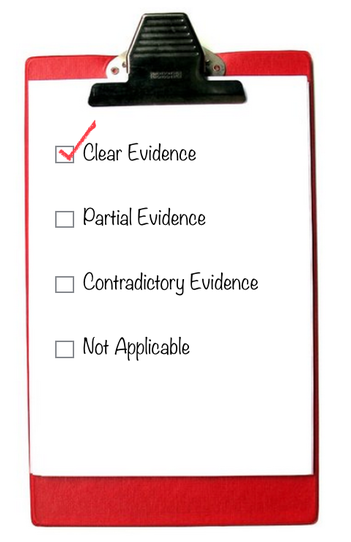
Since the unannounced observations are meant to be short visits to classrooms (lasting about 10-15 minutes), it is expected that some of the elements will not be observed.  In these instances the “Not Applicable” determination will be given. Please remember that this is not a negative determination because it means that there was nothing observable during that short unannounced observation. The negative determination would actually be “Contradictory Evidence” because it means that the teacher observed was actually doing something to show a lack of proficiency in a particular area.

The expectation is that the vast majority of unannounced observations will be comprised of “Clear Evidence” and “Partial Evidence” determinations.  The definitions of each determination are below:
Clear Evidence (E): During the observation, I saw clear evidence of the educator’s proficiency on the indicator.  The guide will be the Proficient definition on the rubric.

Partial Evidence (P): During the observation, I saw partial evidence of the educator’s proficiency on the indicator.  The guide will be the Proficient and Needs Improvement definitions on the rubric.

Contradictory Evidence (C):  During the observation, I saw evidence that the educator clearly lacked proficiency on the indicator.  The guide will be the Proficient and Unsatisfactory definitions on the rubric.

Not Applicable (N): During the observation, the educator’s practice did not include elements defined in the indicator.  This is not a negative rating, but rather an acknowledgement that the indicator was not addressed.

My Weekly Diigo Bookmarks (November 9, 2014)

Posted from Diigo. The rest of my favorite links are here.

My Weekly Diigo Bookmarks (November 2, 2014)

Posted from Diigo. The rest of my favorite links are here.