With the school year having just ended, I am excited to veer off into a few personal learning endeavors that I hope will help me grow as a learner and as a school leader. My first undertaking this summer is the start of a six-week online experience called #PTcamp which centers around Beyond the Bake Sale, the Essential Guide to Family/school Partnerships. This free and open course involves 100 educators from around the world and will include Anne Henderson and Karen Mapp for discussions about different topics from the book.
Category: Uncategorized
My Weekly Diigo Bookmarks (June 22, 2014)
-
A Smart Way to Skip College in Pursuit of a Job –
From Eduardo Porter in the New York Times
-
from Mother Jones
-
How to Create Augmented Reality Layers of Information on Aurasma
-
How to Combine Tellagami Clips in iMovie
From Richard Byrne
-
Awesome Timeline Chronicling The Use of Educational Technology in Schools
-
Kaizena Adds Support for Giving Audio Feedback on Google Presentations
-
Will California’s Ruling Against Teacher Tenure Change Schools? – Dana Goldstein – The Atlantic
-
Greatist Lists Midstate Trail As Hidden Hike to Try This Summer | BostInno
-
Un-Fathom-able: The Hidden History of Ed-Tech
From Audrey Watters
-
Suspensions, Expulsions, Arrests Don’t Work: On School Discipline, We Can Do Better
From Real Clear Education
-
Looks like a great tool for giving feedback on writing https://t.co/M4Jv8Nlc27 #edtech #edchat #dcmooc
-
“Digital Investigations (and inquiry projects): The Gold Standard(s)?” http://t.co/npigMPFNth #thoughtvectors
-
Aspen Report Validates and Accelerates Shift to Connected Learning – Getting Smart by Tom Vander Ark
-
American schools need better teachers, so let’s make it harder to become one.
Article in Slate by Amanda Ripley
-
Classroom Culture: It’s Your Decision | ASCD Inservice
From Sean Slade at ASCD – What kind of culture do you want to take hold in your classroom? The decision is primarily yours. Because what you do and how you do it affects how your students interact, inquire, respond, cooperate, collaborate, discover, and it develops the dominant culture of learning for your classroom.
-
The A-List Collection by Michelle Luhtala
Great list of apps from Michelle Luhtala
-
From Alfie Kohn
-
Thinking About The R in SAMR – Edudemic
#Work that matters! Check out @patrickmlarkin’s post Thinking About The R in SAMR http://t.co/rO8BJtNiFA #vsblearns #edtech
-
Innovative Education: Make Room for “What Ifs”
From Suzie Boss on Edutopia
-
Upgrading Blogs Through Lens of SAMR
From Silvia Tolisano – My ultimate goal for using a classroom blog or student blogfolios though, is that of creating transformative teaching and learning opportunities, not to have a platform that substitutes a composition book or paper journal.
My Weekly Diigo Bookmarks (June 15, 2014)
-
A further look at Google Classroom which is due out in the fall=
-
How to Flip Your Classroom With eduClipper and PixiClip
From Richard Byrne – Teachers interested in trying the flipped classroom model often ask me for recommendations for video creation tools. They also often ask me for ideas on sharing videos without using YouTube. One answer to both of these questions is to use eduClipper.
-
Three Good Places to Find Historical Images – And an Idea for Using Them to Spark Discussion
From Richard Byrne – One of my favorite ways to spark students’ interest in a history lesson is to have them look for interesting historical images. I’ve found that interesting images can prompt good conversations which in turn lead to good questions for my students to research the answers to.
-
Why Storytelling Is The Ultimate Weapon
Jonathan Gottschall, author of The Storytelling Animal, says science backs up the long-held belief that story is the most powerful means of communicating a message.
-
The Best Posts On Students Evaluating Classes (And Teachers)
Good resources from Larry Ferlazzo regarding students evaluating their teachers.
-
12 Awesome Marketing Tools You’ve Never Heard Of
From moblized
-
September 21st, 1967 – You’re Getting Old!
Cool Graphic for people to put their age in perspective.
-
Create Your Own Personalized Podcast Using Voxer
From Joe Mazza regarding how to use Voxer to create a Podcast or to network with your PLN.
-
GooglePlus, Twitter, YouTube, LinkedIn – Complete Social Media Sizing Cheat Sheet – infographic
-
The 74 school shootings since …
Map via @Everytown
-
Google Hangouts 101 and Sharing Lessons with Google Tools
From Wes Fryer
-
This event on May 14, 2014 in Cambridge Massachusetts was sponsored by CPS, Citizens for Public Schools
-
Getting more from Book Creator
Inspiration, ideas and resources for getting the most out of Book Creator for iPad
-
How Bill Gates pulled off the swift Common Core revolution –
My Weekly Diigo Bookmarks (June 8, 2014)
-
21 Good iPad Apps for Middle School Teachers to Try This Summer
From Richard Byrne
-
A Core Curriculum To Create Engaged Entrepreneurs | Co.Exist | ideas + impact
From Cathy Davidson in Fast Company
-
This page offers performance information for Google Apps services. Unless otherwise noted, this status information applies to consumer services as well as services for organizations using Google Apps.
-
Analyzing iPad Myths in Education
Many obstacles that iPad cynics attempt to put in place when discussing a roll-out are based on untruths, poorly research and/or out-of-date information. I was delighted when my Canadian Twitter friend and fellow iPad blogger, Steve Lai decided to join forces, as we’ve done before, to combat this dis-information that floats around the education profession worldwide.
-
Is Google Making Us Stupid? – Nicholas Carr – The Atlantic
Is Google Making us Stupid? http://t.co/uriuIX3j5E
-
21 Great Apps for Pre-K through 2nd Grade Teachers to Try This Summer
From Richard Byrne – The summer is a great time to explore new-to-you iPad apps that you might want to add to the iPads that you have in your classroom. Each day this week I’m going to share a selection of apps appropriate for four ranges of pre-K-12 grades.
-
In Kentucky, Students Succeed Without Tests
From NPR
-
Last Week Tonight with John Oliver (HBO): Net Neutrality – YouTube
Cable companies are trying to create an unequal playing field for internet speeds, but they’re doing it so boringly that most news outlets aren’t covering it. John Oliver explains the controversy and lets viewers know how they can voice their displeasure to the FCC.
-
Grammar Bytes is a Great Site for Developing and Testing Grammar Skills
-
Moving at the Speed of Creativity | Why Edward Snowden’s Disclosures Are Terrifying
PBS Frontline special, “United States of Secrets.”
-
A Short Example of the Benefits of Classroom Blogs
From Richard Byrne – a new slideshow about the benefits of having a classroom blog
The Positive Power of #Edcamp Hits The US Department of Education
![]() |
| photo via Joe Mazza |
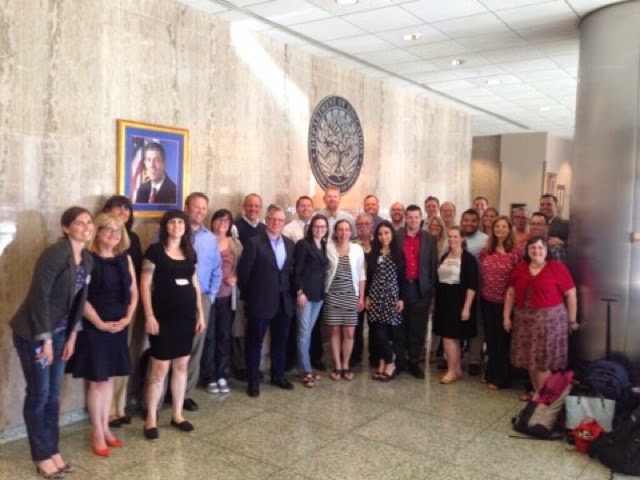
It was an honor to be involved in the first #edcampusa today held at the United States Department of Education in Washington, D.C. Despite the relatively small size of the #edcamp, with only 75 in attendance, I believe that this was a big deal. It showed the willingness of the staff at our nation’s department of education to go outside of their comfort zone and welcome a large group of visitors to their space for the day. I think it’s awesome that our Secretary of Education and his staff were intrigued and wanted a first hand view of what this whole #edcamp movement is about.
As is usually the case with #edcamps, those in attendance created an amazing agenda and left all of those in attendance with plenty of meaningful ideas to share with all of the learners they connect with.
My Take Aways of #edcampusa: The value of leadership, the need for high quality PD, and all we do is about relationships. @usedgov
— Tom Murray (@thomascmurray) June 6, 2014
Breaking down the tweet a bit, I am optimistic about the fact that the folks who set the national education agenda in Washington opened the door for a group of passionate educators to share that passion. The Department of Ed. staff who spent the day in sessions saw the power of teacher-led professional development and the importance of learners taking control of their own learning. Lastly and most importantly, relationships were made and/or extended that will lead to more conversations.
Let’s face it, this #edcamp thing is no longer a secret with well over 400 #edcamps having been held since the initial #edcamp back in 2010. Whether today’s event leads to great changes at the federal level or not, the #edcamp movement will continue to grow.
Vision – We are all self-directed learners, developing and sharing our expertise with the world.
Mission – We build and support a community of empowered learners.
Today Edcampers did what they do, sharing their expertise and building their community! The only people who will really decide where this goes next are #edcampers. I am hopeful our friends in Washington liked what they saw and will join us on this fun ride!
My Weekly Diigo Bookmarks (May 25, 2014)
-
What Is Creative Commons and Why Does It Matter?
From Graphite
-
Ideas for Using Augmented Reality in Elementary School Lessons
-
Burlington Public Schools News
-
01803Phone
-
-
Report highlights impact of more time for teacher collaboration | EdSource Today
More hours in the school day for teachers as well as students can lead to improved academic achievement, according to a new report that studies 17 schools across the nation that give teachers more time for collaboration and professional development.
-
The towns and cities with the best-paid teachers in Massachusetts in 2013 (BBJ DataCenter)
-
A different way to implement Common Core
From the Washington Post – Co-written by Randi Weingarten and Linda Darling-Hammond
-
Free and easy ways to connect with your staff & parents!
From Amber Teamann
-
Write your way into the day, lesson, meeting, keynote
From Zac Chase – The benefits of having an audience journal before the lesson, presentation, staff meeting, etc.
-
Cultivating a Culture for Peer Observations
via ASCDInservice
-
Turn your favorite photos and videos into Google+ Stories and Movies
From Google Gooru
-
Using Social Media as a Teaching Tool
Via Kristen Wideen – Great examples of the value in utilizing social media in the classroom
-
High School Gym Classes Get a 21st-Century Makeover
From US News
-
Why I Find Standards-Based Grading Fascinating
From Michael Pershan
-
Choose Your Own Adventure With Google Drive
a three-level, “Choose Your Own Adventure With Google Drive,” learning experience for educators. – See more at: http://www.shakeuplearning.com/blog#sthash.toUir8Nv.dpuf
-
The Beginner’s Guide To Response to Intervention (RTI)
From Edudemic – Response to Intervention or RTI is an essential approach that brings science and the art of teaching together. Response to Intervention practice promotes education through innovation and creativity. The foundation of the entire approach is firmly grounded on taking decisions based on data analysis of student’s learning capability.
My Weekly Diigo Bookmarks (May 18, 2014)
-
Informative Infographic or LGBT Rights around the world
-
From Richard Byrne
-
From Richard Byrne – The app is one part calculator and one part mathematics tutorial. When students enter an equation into Math 42 they not only receive the answer they also receive a break-down of the steps needed in order to solve the equation.
-
From Peter Pappas
-
From Common Sense Media – Common Sense Media’s research report shows kids are reading less than ever. Discover the startling statistics — and what you can do to get your kids back into books.
-
Important article for T’s and P’s to read. http://t.co/hO7I9cZxWQ #edchat #edpolicy
-
some helpful resources emerging for administrators and edleaders who want to do this and do it right.
-
“@schink10: ComPassion Based Learning: The Coolest Thing I Have Ever Seen. http://t.co/HWuWiKJalW… you should join this
-
By Derek Thompson – The Atlantic
-
From the New York Times – For Some Social-Media Users, an Anxiety From Approval Seeking
-
From Richard Byrne
-
Interesting post on the fact that people need to look beyond views regarding the effectiveness of YouTube Channels as a marketing tool.
-
Kaizena is an outstanding web based tool that allows teachers to provide audio feedback on student work that has been created and shared through as Google Docs. Kaizena is not a native tool in a Google Drive account, but can be added through the Google Drive apps store.
-
Check out these projects from our friends @EnvisionSchools! – http://t.co/2FeeMvc5ov #DeeperLearning #PBLChat #PBL
-
From Vicki Davis – UDL advocate Karen Janowski shares a power-packed 10 minutes of ideas for designing online learning experiences to reach every child.
-
From Holly Clark
-
“@PearsonSStudies: A list of over 100 great sites for #socialstudies! http://t.co/33u2MbDHGN #sschat #history #resources” #phspln
My Weekly Diigo Bookmarks (May 11, 2014)
-
Shifting Our Focus To Local Assessment
From Grant Wiggins
-
Computerized Grading: Purloining the Analysis, the Most Fundamental Exposition of Humanity
From Anthony Cody in Edweek
-
Tech resources that can be used in lieu of textbooks from Rice University
-
4 Powerful Formative Assessment Tools For The Chromebook Classroom
-
Competency-based Teacher Infographic | e-Learning Infographics
How the role of teachers is changing amid broader shifts to personalized, blended and Deeper Learning. http://t.co/t6uin2PaRv #k12 #educhat
-
The Challenge of “Calibrating” Teacher Observations
The Challenge of Calibrating Teacher Observations http://t.co/QT9s3fNyZ4
-
This is not a John Lennon quote and I lose my mind
This is not a John Lennon quote and I lose my mind every time I see it. RT @HUMANBElNGS http://t.co/1zhf1RvzU3
-
A good overview of the Canvas LMS
-
Early Reports Suggest Few Field-Testing Snags
From EdWeek
-
Rewordify.com: Understand what you read
Rewordify.com helps you read more, understand difficult English faster, and learn words in new ways. Just paste in difficult English (or enter a web page URL) and click the yellow button.
-
You should know what “net neutrality” is. If you don’t, here’s a quick, fun way to catch up…
From 22 words
-
Is Raging Against the Machine Our Only Option?
From Cathy Davidson
-
Project Based Learning – An Explanation and Model Rubrics
From Richard Byrne
-
Rethinking Classroom Observation
From ASCD’s Ed. Leadership – Flipped peer observation leads to job-embedded teacher learning.
-
Reimagined:Your 1:1 Program: Can You Answer These 10 Questions?
-
Social media advice for career-minded students. 10 things to consider.
-
Are You Checking Work Email in Bed? At the Dinner Table? On Vacation?
From Clive Thompson in Mother Jones: New research suggests that asking too much of workers during off hours can seriously backfire.
-
ISTE based learning experiences available from @cathywo https://t.co/ime324ct7x #edcampbos
-
Games Are Good for You! What Games Teach Us About STEM & Learning
For more coding ideas after @katewilson13 session, check out her webinar from last week http://t.co/0axGAqesUV #HLBC14
-
Free Technology for Teachers: AnswerGarden – Embed an Open Response Feedback Tool Into Your Blog
AnswerGarden – Embed an Open Response Feedback Tool Into Your Blog via Free Technology for … http://t.co/olHaHxZFK3
-
Pearson Wins Major Contract From Common-Core Testing Consortium – Marketplace K-12 – Education Week
Pearson gets the PARCC contract. And was the only ultimate bidder: http://t.co/1YlMCSTmUu
-
Christa McAuliffe Technology Conference
The Call for Presenters for CMTC 2014 is now open! http://t.co/PbZJug9TAs #nhcmtc #edcampBos
-
Great Tech for Online Writing and Blogging
Writing clearly is an essential skill for all students. Take their abilities to another level: http://t.co/jEoiYgHv0J http://t.co/yRIXs8mXre
-
Summer of Learning 2014 | Evolving Educators
RT @ScottRRocco: Summer of Learning 2014 http://t.co/ob2hb6zmCq #satchat #njed
-
Response:’The Grading System We Need to Have’ is my new Ed Week post w/ @RickWormeli & others http://t.co/Fd6ojsqNQh http://t.co/ZmSmN19mza Wow, @RickWormeli on “Grading System We Need 2 Have” may end up being most popular post ever in my Ed Wk advice blog http://t.co/0vsRrQXsxO
-
NY State Assessment Blues – YouTube
NY State Assessment Blues: http://t.co/dkCidOENOT @carolburris @dianeravitch @leoniehaimson @scfeeney @donald_gately @posroff @dgamberg
My Weekly Diigo Bookmarks (May 4, 2014)
-
Stop Worrying About Your Child Getting Into College. Worry About What Happens Next.
From The New York Times Parenting Blog
-
An Introduction to the New Google Drive iPad Apps That Offer Better Offline Support
Great overview by Sam Morra
-
A Simple Way to Create A Search Engine of Educational Videos for Your Class
Here is how you can build your video search engine
-
6 reasons to reject Common Core K-3 standards — and 6 rules to guide policy
From Valerie Strauss in the Washington Post
-
Not all scientific studies are created equal – YouTube
A good quick look at research studies and how to judge their reliability.
-
Science Books Online lists free science e-books, textbooks, lecture notes, monographs, and other science related documents. All texts are available for free reading online, or for downloading in various formats.
-
Easily Link to Translated Versions of your Website | Google Gooru
-
-
Getting Staff On Board With iPad Deployment | The GEDB Online Learning Platform
Getting Staff On Board With iPad Deployment http://t.co/00wfvhbsyu
-
Website Domains Help Students Learn How to Shape Their Digital Identities
-
A Twitter Abbreviation Guide To Make Sense Of All That Crazy Talk
-
Here is a short video introduction on why personal knowledge mastery (PKM) is becoming a required skill and mindset for professionals today.
-
From Harold Jarche’s Personal Knowledge Mastery (PKM) Workshop
-
I’ll Be Happy to Tell You What I Don’t Like — Common Core Annoyances
-
Google Doc of Whiteboard Apps
-
From Diane Ravitch – Altogether, 24 people wrote the Common Core standards. None identified himself or herself as a classroom teacher, although a few had taught in the past (not the recent past). The largest contingent on the work groups were representatives of the testing industry.
-
Common Core propaganda fails: Well-financed education “reformers” fight common sense – Salon.com
Big business and corporate media keep pushing the Core and charters schools. The pushback is heartening and real
-
Future of Technology | Pew Research Center’s Internet & American Life Project
Non-internet users broken down by demographic: (http://t.co/4aEgaB9Lgl) http://t.co/stfnZDdIkW
My Weekly Diigo Bookmarks (April 27, 2014)
-
Coleman has it wrong: Children are the core of our schools |CommonCored.us
David Coleman, chief architect of the Common Core learning standards, notably quipped in a 2011 speech at the state Department of Education, “As you grow up in this world, you realize people really don’t give a (expletive) about what you feel or what you think.”
-
This is the future of technology — how will it impact teaching & learning?
from Sam Chaltain – Educators and school reformers — ignore at (y)our peril. (And crazy to think that this talk was from 2005!)
-
Filmmaker Jerry Rothwell on his “School in the Cloud” documentary | TED Blog
a forward-thinking elementary school in the U.K., Rothwell has watched Mitra, a Newcastle University professor, plant the seeds of his global education experiment that lets children learn on their own, and from each other, by tapping into online resources and their inner sense of wonder.
-
Fountain of Youth – Training As You Age | Kap Lifestyle
This is why it’s immeasurably important to keep training into your 30s, 40s and beyond. http://t.co/KVlsAbe0ii … #StayStrong
-
“Many Ways To Help Our Students Grieve”
Good list from Larry Ferlazzo
-
Child Protection: Five golden rules for staying safe online | British Council
Infographic
-
Photograph Math – #mathphotoaday
From Richard Byrne – hanks to a recent Instragram from Andy McKiel I learned about a neat mathematics and photography project started by a grade 3 class in Thompson, Manitoba. The project asks students to take photographs of things representing various topics and concepts in elementary school level mathematics.
-
20 collaborative Google Apps activities for schools | Ditch That Textbook
Some great easy classroom activities for teachers
-
Biz Stone’s No-Homework Policy And The Rules Of Rule-Breaking | Fast Company | Business + Innovation
TWITTER COFOUNDER BIZ STONE IMPLEMENTED A “NO HOMEWORK POLICY” FOR HIMSELF IN HIGH SCHOOL AND GOT AWAY WITH IT IN SPECTACULAR FASHION. HERE’S WHAT IT TAUGHT HIM ABOUT WHEN AND HOW TO BREAK THE RULES.
-
Shifting the Classroom, One Step at a Time
Great advice on moving to an inquiry-based classroom from Shelley Wright
-
Options for Uploading Videos to YouTube with School Filtering
From Wes Fryer
-
Site that can be utilized as an access to textboooks
-
How, after 60 years, Brown v. Board of Education succeeded — and didn’t
-
Lesson Plan Map – Search Education – Google
Google has designed a set of 15 wonderful lesson plans
-
8 Responses to Late Work To Use Right Now –
From ASCD Edge
-
Michelle Ardizzoni – New England 1:1 Summit
-
The Myth Of Digital Citizenship And Why We Need To Teach It Anyway
From Sam Stecher on EdReach
-
Those Terms of Service on Popular Websites DO Matter! | Powerful Learning Practice
From Jen Carey – “If you want to advocate for an effective Digital Citizenship program, you must first take the position that behaving responsibly and appropriately online is paramount. As such, this means not violating a company’s age or usage policy (even if someone in the company might suggest it’s okay).”
-
A Great Student Rubric for Reviewing Apps
To help her students understand and be able to analyze the apps they come across online, Mutt Susan from Digital Divide and Conquer has created this wonderful rubric. The Student App Review Rubric, features five sections ( or criteria) that students can grade when assessing an app. Each of these criteria can be graded with a numerical number from 0 to 4 with 4 as the top grade.
-
School Spotlight: The Notre Dame School of Dallas Facebook Page
A good look at how one school successfully uses Facebook to connect and spread its message.
-
Who Wrote the Common Core Standards? Here is a List
From Diane Ravitch
-
Here is a press release that lists the names of the writing teams for each subject as well as “feedback” groups.
-
-
UN study: Cellphones can improve literacy – The Washington Post
-
What does the SAT measure? Aptitude? Achievement? Anything?
Moreover the nature of these standardized exams — fast-paced, multiple-choice “games” that put a premium on strategic guessing — means that they advantage students with strong test-taking skills, not necessarily those with other talents that may be more valuable in the classroom or in life. Finally, the concept of “aptitude” assumes that it is innate and unchangeable. In fact, humans can develop the knowledge, skills and experiences that improve performance, if given the opportunity.
-
The New Doctopus & Add-ons Gallery – YouTube
The New Doctopus & Add-ons Gallery: http://t.co/rbCnSOGWeW via @YouTube #edtech @dimll
-
Math is Harder When Using an iPad ~ Mrs. Wideen’s Blog
RT @mrswideen: Math is Harder When Using an iPad http://t.co/62VvPIOrxc #ettipad #1stchat #ipaded #mathchat
-
PD Conferences vs. Unconferences
This is the challenge that must be met, “How do we make something that is mandatory for all, excellent enough that we begin to change the brains of 1000 teachers. PD can be a good thing, and you will learn something if you come willing to learn.
-
Technical glitch causes FCAT testing problems in Collier
Computer-based testing issues in Florida
-
Fairfax teens could get extra hour of sleep on school days – The Washington Post
“To do nothing in this situation is to do harm,” Owens said. “You’re perpetuating a situation where not only academic achievement is compromised but their health and safety is compromised.”
-
Confronting the Myth of the ‘Digital Native’
From the Chronicle of Higher Education – This is also a problem at the college level
-
danah boyd | apophenia » Whether it’s bikes or bytes, teens are teens
The irony of our increasing cultural desire to protect kids is that our efforts may be harming them. In an effort to limit the dangers they encounter, we’re not allowing them to develop skills to navigate risk. In our attempts to protect them from harmful people, we’re not allowing them to learn to understand, let alone negotiate, public life. It is not possible to produce an informed citizenry if we do not first let people engage in public.
-
5 Tips For Researching Internships – Chelsea Krost
5 Great Tips For Researching #Internships http://t.co/QG0LA77l22 via @amritsays #Millennials #students #SummerBreak
-
5 Tools That Help Students Organize Research and Create Bibliographies
From Richard Byrne – Organizing and writing a bibliography can feel like the most tedious part of writing a research paper. The following five tools can help students organize and create their bibliographies.
-
iPad As Teacher’s Pet (infographic)
from Tony Vincent
-
Multilingual Lessons for Pre-K through Second Grade Students
via Richard Byrne
-
EverySlide – Share Your Slides and Run Polls At the Same Time
From Richard Byrne – EverySlide is a free (for educators and students) service that allows you to share your slides directly to the iPads, laptops, Chromebooks, and Android devices used by members of your audience.
-
The Fischbowl: Burden of Proof: A Textbook Example
I think that for all “materials selections” from here on out, the default should be to not purchase a new textbook.
-
Why You Have to Generate Your Own Data – Scott Anthony – Harvard Business Review
f you really want to make the case for an innovative idea, then you need to go one step further. Don’t just gather data. Generate your own. Strengthen your case and bolster your own confidence –
-
Actually, online skimming probably hasn’t affected serious reading after all
A more plausible possibility is that we’re not less capable of reading complex prose, but less willing to put in the work. Our criterion for concluding, “this is boring, this is not paying off,” has been lowered because the Web makes it so easy to find something else to read, watch, or listen to.
-
Being a student of your own school
Good overview of the constructive use of Learning Walks and Instructional Rounds
-
Why Playful Learning Is The Key To Prosperity
Learning through play with “hands-on, minds-on” approaches (not workbooks) is a powerful way forward. Play gives children space to dream, discover, improvise, and challenge convention. It’s crucial to social, emotional, cognitive and even physical development, helping them grow up “better adjusted, smarter and less stressed.” We know this.
-
Good list from Harold Jarche about living in the network area
-
Common Core’s power grab -Editorial
Editorial by Peabody School Committee Member Dave McGeney
-
Harvard Measures Its MOOCs – Harvard Magazine |… – Linkis.com
How Harvard Measures Its MOOCs – Harvard Magazine http://t.co/WUJyETEsiX