
-
Good list for summer reading
-
Moving beyond problem admiration
-
“As technology change destroys traditional roles for human beings — and generates new ones — the question of “what’s next” becomes central for each of us.”
-
Dr. Joe Mazza shares some personal insights on cultural during his TEDx Talk at BHS.
-
Great chart to share
-
Good Resources from Larry Ferlazzo’s Weekly UPdate
My Weekly Diigo Bookmarks (June 11, 2017)
-
Good overview of the world’s popuation broken down on a smaller scale.
-
The U.S. Department of Education’s new open licensing rule has gone into effect
-
The Top 10 Fiction Books for Non-Fiction Addicts https://t.co/Gfd5iFiKzK
-
Public Speaking – How I Prepare Every Time https://t.co/iV12vQbbvB
My Weekly Diigo Bookmarks (June 4, 2017)
-
AMAZING TedX from Michael Beirut: How to design a library that makes kids want to read. Hysterical AND inspiring ❤️https://t.co/UIwFQ7nWs8
-
Behind the Scenes: How to Make a Movie Trailer for Your Product (or Book) https://t.co/4SrE8E8HhL
-
Here’s Why Your Innovation Strategy Will Fail https://t.co/JxVnjZIgIb #IMMOOC #InnovatorsMindset
-
Creating Student Driven Digital Portfolios using @SeesawEDU https://t.co/ZW0OLR6dNj via @SamPatue
-
What My Morning Journal Looks Like https://t.co/CepWFY0Gfh
-
Love stop-doing ists…
-
News from the MA State House
-
What is agency? In short, managing your own learning. New Tech schools share rubrics that identify the ability to develop and reflect on growth mindset and demonstrate ownership over one’s learning. Below is the rubric for fifth grade.
-
The God of Curriculum: Which Learning Matters? https://t.co/mFqQLCE5TF #edchat https://t.co/59amDp0VTN https://t.co/reecICteNu
-
Kudos to @newtechnetwork for sharing its #PBL rubrics for all levels K-12 #edleader21 #21stedchat #pblchat https://t.co/5flg7TvjkB
My Weekly Diigo Bookmarks (May 28, 2017)
-
‘Unrealistic’ Athletic Goals: Why and How to Pursue Them https://t.co/ga7reFRk0C
-
About the book – ““Structuring Equality shows us how to turn the theories of Dewey, Freire, hooks, and Dweck into actual pedagogical practice. It’s a step-by-easy-step guide, with essays, lesson plans, and assignments designed to enliven and inspire any classroom. “
-
From Amber Teamann “These activities are more FUN than what we typically see in a PD setting, but this is also a GREAT time of year for teachers to remember that learning can (and should) be fun!”
-
From Joan Seidta – “The term adolescent literacy can be misleading – adolescent literacy is not limited to teenagers! This label is used to describe literacy skills for students in grades 4-12. The axiom that through grade 3, students are learning to read, but beginning in grade 4 they shift to reading to learn (Chall, 1983), sums up why grade 4 is the logical place to make the jump from early literacy to adolescent literacy.”
-
“It acknowledges differences between students. What distracts you might not distract me. My cell phone distracts my learning so it goes in the box. Your cell phone helps you learn so it stays on your desk.”
-
It’s only a matter of time! https://t.co/TqnSOk0XSY
My Weekly Diigo Bookmarks (May 21, 2017)
-
“The Genius Hour Blueprint covers six different phases of Genius Hour and what steps/activities you can do at each stage. It also has suggested resources, activities, and ways to share your work broken down by K-5, 6-8, and 9-12.”
-
Great resource from Teaching Tolerance
-
“Although almost all evidence-based SEL programs are centered around the student, only a few give students agency to create and direct their learning. According to the recent World Economic Forum Report on SEL, a projected 65% of children entering grade school will work in jobs that do not exist today. This means we need students to feel empowered not just to direct their learning, but to create their own job opportunities.”
-
From Edutopia – “Open educational resources are free digital materials you can use with your students. Here are some ways to find them. “
-
School Districts Struggle to Hire Minority Teachers | Pennsylvania News | US News https://t.co/wVY7QAX9Lz @TJacksonBristol
-
From Richard Byrne – “Anchor is a simple and free platform for creating short podcasts.”
My Weekly Diigo Bookmarks (May 14, 2017)
-
@patrickmlarkin Planned a lesson around these in my 6th grade Science class, pretty sure it was a favorite with my… https://t.co/NSk5uwN8aP
-
From Ken Kay – “Unlike a mission or vision statement, a graduate profile is a document that a school or district uses to specify the cognitive, personal, and interpersonal competencies that students should have when they graduate.”
-
From The New York Times – “The tech giant is transforming public education with low-cost laptops and free apps. But schools may be giving Google more than they are getting.”
-
From Richard Byrne – “Yesterday, I was asked about the difference between augmented reality and virtual reality. I made the following video and short slideshow to further explain the differences between the two.”
-
Ss community created tours? Create your own Street View imagery with new 360 cameras https://t.co/bbF1QHDS9X
-
“this type of program starts conversations and kids can find relevance in their communities.” #bhschat #bpschat https://t.co/A4nRROBU9R
-
From Richard Byrne – “Last week’s viral Google Docs phishing scam provided a good reminder to many that we should always give a critical eye to emails and social media posts that don’t look quite right. It also served as a reminder that we need to educate students and, sometimes, our colleagues about phishing attempts. Common Craft has an excellent video on the topic. You can watch the video as embedded below or on the Common Craft website.”
-
From Vicki Davis – a variety of digital tools to help teachers check for understanding.
-
From Harold Jarche – “Training as knowledge delivery is dead. When this is needed, such as learning how to do a procedural task, it will be automated through simulation.”
-
from Will Richardson – “Because it’s about teaching, achievement, productivity, ease of use, dazzle… …not learning.”
-
“A hungry child between the age of 6 and 12 is more likely to receive special education services, repeat a grade in school or receive mental health counseling, than a child who is not hungry, according to the American Psychological Association.”
-
From an expert – “As a national board certified Early Childhood teacher and a parent that has spent the last five years researching sensory processing, the benefits of sensory play and fidgets, I have to say I’m actually appalled.”
-
from John Spencer – “But the secret ingredient wasn’t a new maker space or a fancy studio (my students shot the videos on their cell phones). It wasn’t a new program or a district initiative. No, the secret ingredient was ownership. Without the curriculum map, we were forced to go off-road. And, although the road was rocky (hmm . . . rocky road) it was also an epic adventure.
-
From Eric Sheninger – “Narratives both large and small are valued as tangible evidence of the school’s worth. Stories come in different sizes and hold different purposes, but simply said they keep the engagement going. Sharing through big and small ideas aligned to the focus areas above will result in greater transparency that will help to build better relationships, support, and admiration for your noble work.”
-
From Pernille Ripp “I think of the power we hold as the previous teachers of these kids. Of how we decide what gets shared. Of how we decide what is told. Of how we decide what to focus on and we pass that on to the teachers that do not know them yet. So tell the full story, and if you don’t have the full story yet find it before it is too late. “
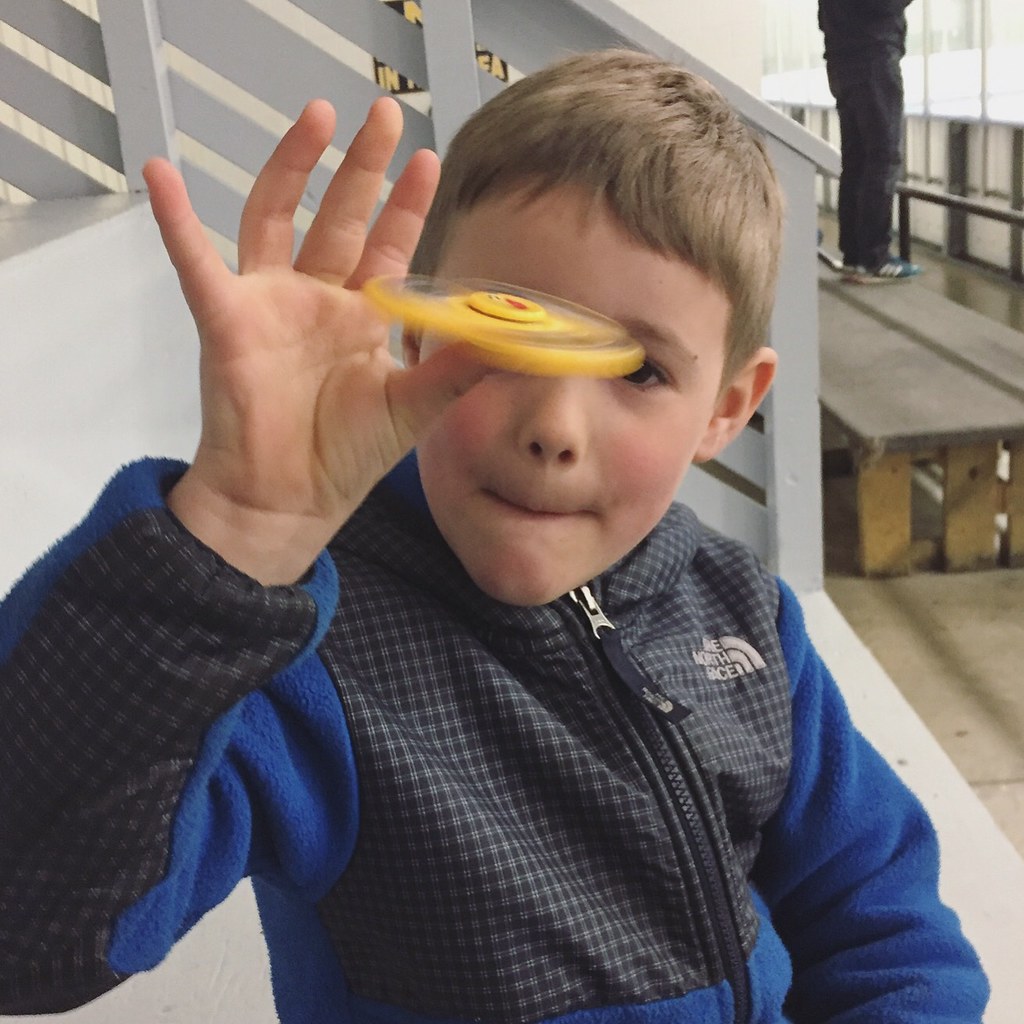
Are Fidget Spinners The Problem Or Is It Our Mindset?
 |
| photo via https://www.flickr.com/photos/meesterdickey/ |
The recent uproar about fidget spinners in schools has me reflecting about my recent post on the potential problems incurred by organizations that solve all of their problems through a strict adherence to the policy manual. While the United Airlines story was certainly an extreme case, I do think we miss out on some valuable opportunities when we just take a hardline approach and not engage in some constructive dialogue about other options.
While I am not sure how long the fidget-spinner fad will last, I do know that it will begin to fade at some point. I also know that there will be some new gadget or gizmo that will become the next hot item that our kids will want to have in their hands. Will we add that to our growing list of banned items or will we instead take the opportunity to have a constructive dialogue with our students.
When we jump to ban things, we fail to give our students credit for the fact that they are capable of discussing behavioral expectations. We send the message that we don’t trust them and that we will need to step in to protect them from themselves. My experience has been to the contrary and I know that students can help us articulate how, when and where a fidget spinner or the next thingamabob should be used in the context of school. If we are wrong, we can always go to the ban as step two.
Missed Opportunities
It’s funny, the first time I saw a fidget spinner was while walking through our middle school classrooms and one of the science teachers was making them with his students. He was excited to show me the spinner and talk about the science involved with his students. I wonder how many other science teachers took this opportunity?
A few weeks later, my 11-year old daughter purchased one at a local toy store and then we went home and looked on YouTube for some of the tricks that we could try with the spinner. It was fun to share that time with her and see what the kids were getting so excited about. As adults, I think it is important to get some firsthand experience with something before we make up our mind about it. We need to take an interest in their interests and not just brush them aside as trivial.
In the end, my daughter decided not to take hers to school because she did not see a time in her school day where the fidget spinner would be valuable to her. But the important thing was that she was able to make that decision for herself.
The best example of what can happen when we collaborate with our kids on things like spinners comes from the news segment below from Alabama where educators decided to build lesson plans around this item that has captured the attention of so many students. It is sad to me that the majority of headlines on fidget spinners were negative and that we did not see more schools and classrooms look at this as a chance to make meaningful connections with students.
Unless we are talking about a safety issue, we need to ensure that we are not invoking the centuries-old “ban reflex.” Do we see problems first or opportunities?
http://WBRC.images.worldnow.com/interface/js/WNVideo.js?rnd=408742366;hostDomain=www.wbrc.com;playerWidth=580;playerHeight=360;isShowIcon=true;clipId=13314291;flvUri=;partnerclipid=;adTag=News;advertisingZone=;enableAds=true;landingPage=;islandingPageoverride=;playerType=STANDARD_EMBEDDEDscript;controlsType=fixedWBRC FOX6 News – Birmingham, AL
My Weekly Diigo Bookmarks (May 7, 2017)
-
Here is a great blog challenge…take one “life lesson” from this article and blog about it: https://t.co/gWYLvNqydF Working on mine now.
-
The results show that race-based bias already exists around the second half of a child’s first year. This challenges the popular view that race-based bias first emerges only during the preschool years.”
-
There are a lot of ways to measure the quality of a high school. The way that U.S. News does it is as follows: 75% of the score is the percent of 12th graders who get at least a 3 on at least one AP test. 25% of the score is the percent of 12th graders who took at least one AP test. They call this weighted average the ‘College Ready Index.’ By including the participation rate, a school can’t inflate their scores by only allowing students to take the AP who are most likely to pass.
-
From David Wiley
-
The connection between addiction and isolation
-
A well-executed newsletter is a powerful email tool with multiple benefits, which is why it’s crucial to ensure your newsletter design is visually appealing. If it looks good, readers are more likely to click.
-
From Meriden CT – “A multipronged approach to improving services for students with special needs.”
-
Let’s bring the faculty book club discussion group back to Wilmington! And btw – this book is next up on my readin… https://t.co/eOOaPYJaDj
-
Good thoughts from George Couros on moving from tech leads to innovative teaching and learning leads.
My Weekly Diigo Bookmarks (April 30, 2017)
-
Learning In Burlington: Is Your School Like United Airlines? https://t.co/nNpdYqgU2n a must read via @patrickmlarkin #ita17
-
Three strategies to practice reflective urgency: https://t.co/NeRhBxBKuc
-
Thanks for your help, Patrick. I had a lot of fun with all my friends at Fox Hill! https://t.co/iGJzrZ6SSM
-
Enjoyed many of these – 50 Top Motivational Quotes to Inspire You to Achieve Your Goals https://t.co/70yqQQsOoE
-
To improve, we must know our biggest failings. In the training and development field, our five biggest failures are as follows: We forget to minimize forgetting and improve remembering. We don’t provide training follow-through. We don’t fully utilize the power of prompting mechanisms. We don’t fully leverage on-the-job learning. We measure so poorly that we don’t get good feedback to enable improvement.
-
High school Ts! Lesson plan to teach Ss how websites collect personal info + what to do about it… https://t.co/FClR9kwdCs
-
Creaturizer from PBS Kids is a free iOS and Android app that lets students create fun cartoon creatures then place them into outdoor settings through the use of augmented reality.
-
If we leapfrog ahead ten years and take notice of the radically different lives we will be living, we will notice how a few key technologies paved the way for massive new industries. Here is a glimpse of a stunningly different future that will come into view over the next decade.
Monday Must-Reads – April 24, 2017
As a means to try to get myself writing in this space a bit more, I am starting each week by sharing three posts that I came across during the previous week that struck a chord with me. While my intentions are mainly self-serving, I am also hoping that a few folks might catch a post that they missed.
Let’s see how many weeks I can keep this up…Four weeks and counting…
1. 72 stunning things in the future that will be common ten years from now that don’t exist today – Thomas Frey
In this post from his site, Futurist Speaker, Thomas Frey reminds us of all of the innovations that we have seen in the last 10 years (i.e. FitBit, Netflix, Facetime, Uber, etc.). With this in mind, he looks at some of the things we can expect to see in the near future.
“If we leapfrog ahead ten years and take notice of the radically different lives we will be living, we will notice how a few key technologies paved the way for massive new industries.Here is a glimpse of a stunningly different future that will come into view over the next decade…
3D printed makeup for women…
For education and training, we will see a growing number of modules done in both virtual and augmented reality…
Crash-proof cars. Volvo already says their cars will be crash-proof before 2020…
Smart chairs, smart beds, and smart pillows that will self-adjust to minimize pressure points and optimize comfort…
Facetime-like checkups without needing a doctor’s appointment…“
2. How Rudeness Stops People from Working Together – Christine Porath
Christine Porath discusses a recent study from medical settings and how incivility among team members can result in poor medical outcomes for patients. There is little doubt that similar behavior by team members in and professional setting can lead to poorer outcomes. Sometimes individuals impacted are not even aware of their detachment.
“People who lack a sense of psychological safety — the feeling that the team environment is a trusting, respectful, and safe place to take risks — shut down, often without realizing it. They are less likely to seek or accept feedback and less likely to experiment, discuss errors, and speak up about potential or actual problems. Even without an intimidator in the room, they work in a cloud of negativity and are unable to do their best.”
For more on this topic, check out Porath’s new book Mastering Civility: A Manifesto for the Workplace
3. Plum’s Creaturizer – A Neat AR App to Get Kids Exploring Outdoors – Richard Byrne
Just in time for the warmer weather, Richard Byrne provides an overview of a great Augmented Reality app that allows them to place fictional creatures in real-world settings. The app is designed by PBS Kids and it is free on Android and iOS
 My Un-Learning Journey