The New Massachusetts Framework for Educator Evaluation – What are the goals?

In my last post, I asked the following questions about our states new evaluation system:  

Will all of this work being done by schools across the state to change the way we do teacher evaluation result in more engaging learning environments that prepare our students for the ever-evolving job market in the “real” world? Is that even the goal of this whole undertaking?

So here is what the state Board of Education stated as its objectives when it voted to adopt a new model for teacher evaluation:

  • Promote growth and development amongst leaders and teachers,
  • Place student learning at the center, using multiple measures of student learning, growth, and achievement,
  • Recognize excellence in teaching and leading,
  • Set a high bar for professional teaching status, and
  • Shorten timelines for improvement.
A member of the Massachusetts Task Force on the Evaluation of Teachers and Administrators also stated the following:

“More than anything, evaluation systems should be recognizing, developing, and promoting the most talented and successful educators. We need an approach to evaluation that is all about celebrating excellence, and ensuring that those who excel also thrive in their workplaces, and stay in education.”

While I agree with most of the bullets and the majority of the statement above, I think it is important that we take a step back and look at how we got to the point where our state and most other states have started to overhaul their teacher evaluation procedures.  We have to be sure to recognize the fact that a change of this nature is as much an adaptive (cultural) change for teachers as it is a technical change. Educational communities that embrace this fact and implement a transparent approach centered around focused conversations about teaching and learning will see success. If the focus is purely on meeting the new timelines and ensuring that every one of the 33 indicators is checked off then the results impact on teaching and learning will be limited.

Before I discuss some of the specific things that I think will help us make the transition to a new evaluation system successful, I think it is important to talk about why we are here. My next post will discuss how the poor job that schools have done evaluating teachers has gotten us to this point.

Can We Evaluate Our Way To Better Schools?

I spent three days last week at a workshop on the new Massachusetts Framework for Educator Evaluation.  The workshop facilitator did a wonderful job providing technical support and also leading us in some rich conversation about teaching and learning.

As we gear up for this undertaking in Burlington, I can’t help wondering how we will look back upon this endeavor a decade from now? Will all of this work being done by schools across the state to change the way we do teacher evaluation result in more engaging learning environments that prepare our students for the ever-evolving job market in the “real” world? Is that even the goal of this whole undertaking?

Enhanced by Zemanta

School Administrator Virtual Mentor Program #SAVMP

I was thrilled when my friend George Couros came up with the idea to pair veteran school administrators with new school administrators for virtual mentoring during the the 2013-2014 school year. It is a great opportunity for all administrators (old and new) to learn together with a focus on clear standards that will help support both the growth of school leaders and the improvement of their schools. 

Please share this great opportunity with the school leaders you know! 

School Administrator Virtual Mentor Program #SAVMP

Looking to help develop administrators to lead innovative school environments that meet the needs of students today, we have decided to start the “School Administrator Virtual Mentor Program” (#SVAMP). This program is to pair a new administrator with one that has more experience. This is not meant to be the typical “mentor-mentee” relationship, but the hope is that through active sharing, each administrator will be help to learn from each other, and others can learn from all of the shared experiences.

Program Design
This program is meant to last for the 2013-2014 school year (typically August to June) although it is open to administrators from all over the world. Each person that is a “mentor” will be paired with three (maximum) “mentees” that they will be able to connect through virtual means (email, twitter, videochat, etc.) to help them develop their leadership. There will also be an online sessions (once a month) that will help to share ideas for learning and leading with guest speakers. All of these talks will be archived and shared if they do not fit into your regular schedule. This is more than likely to be done through the use of Google Hangout.
All of the standards that we will be focusing on will be based on the Alberta Principal Quality Standard. They are as follows:
1. Fostering Effective Relationships
2. Embodying Visionary Leadership
3. Leading a Learning Community
4. Providing Instructional Leadership
5. Developing and Facilitating Leadership
6. Managing School Operations and Resources
7. Understanding and Responding to the Larger Societal Context

Although these “standards” were created within the province of Alberta, Canada, they are not unique to other areas of the world. The focus will be to continuously look at these standards and how they look in schools currently. The hope, through open group forums and mentoring, is to look at all facets of leadership that take place within schools.

This should NOT replace mentorship within your own organization, but is to give you an outsider perspective to leadership that you may not be receiving. It would be beneficial as a new leader to have mentorship within your own school/district.
Program Requirements
Each “mentee” will be required to keep an open blog to share their learning openly with the world, while also helping to create a digital portfolio of their work. Each “mentor” that takes part in the program should already have a blog to model what we are expecting from the people that they are mentoring. It will also be required that participants have a Twitter account that they will use to actively engage and share their learning with others in the program through the #SAVMP Twitter hashtag.
Since the program is free, the expectation to share through a blog and Twitter is crucial. Mentors should have a minimum of three years in administration. This is not limited to Principals, but we encourage Assistant Principals (Vice, Associate, etc.) to apply as well.
Application Process
To apply for this program, you will need to simply fill out the form below and indicate whether you want to be a “mentor” or “mentee”. Although there is a lot of interest to do both, you will have to choose one role.
Once applications are received, we will be looking to pair people with one another that are in the same continent. The hope is to get an outsider perspective on education and learn from a variety of people and viewpoints. We are hoping to accept all of those that apply, but it is crucial that we keep the “mentor-mentee” ratio no higher than 1:3.

Applications will be considered on a first-come, first-serve basis. Location will also be considered to try to pair up applicants to someone in a relatively close time zone. There are no set limits to the program for numbers, only to honour the 1:3 ratio.

Program Focus

To clarify, this is not focused on the development of leaders to use social media, but to help leaders openly learn and share with others so that we can all improve practice and do what is best for kids. This is also focused on helping to build relationships with a few people that you are able to bounce questions and ideas off of that you have known over time. It is imperative that we promote the use of social media to create strong relationships to enhance leadership.

If you have any questions specifically about the program, please do not hesitate to contact georgecouros@gmail.com.

Top Posts #10 – Our School’s Apple School Profile Video

As I look to unplug a bit during the first week of summer vacation, I am continuing to repost my top posts from last year. Below is #10 which was first posted last month.

My daily google alerts notified me that the school profile video of Burlington High School posted on Apple’s Education page in March is now available on You Tube.  The video was posted on May 30 on a You Tube Channel titled Every Apple Video.

Top Post #9 – The iPad In Schools: Is It A Solution Or A Problem?

This was cross posted on Edudemic

As I look to unplug a bit during the first week of summer vacation, I am continuing to repost my top posts from last year. Below is #9 from April of this year.

 Slide via Greg Kulowiec 
Slide via Greg Kulowiec 

 The question above comes from Greg Kulowiec’s Keynote Presentation last Thursday – What is the answer with iPads? – at the iPad Summit in Atlanta, and it is a critical question for educators involved in iPad initiatives (or any 1:1 initiative) to reflect upon. Thinking as a school administrator who pushed for the deployment of over 1,000 devices in his school, I have to admit that I initially responded somewhat defensively as I went with iPad as a solution. However, as Greg allowed the question to linger and began his rationale for looking at iPad as a problem for schools, I began to cast aside my blinders and look at this question from a broader perspective. When Greg asked the following question, “Are we just taking iPads and slapping them into our existing structure?” I knew I had blown it with my initial answer: Of course, I knew that looking at iPad (or any device) as the solution infers a pretty simplistic look at the issues inherent with our current educational system. It also takes away the ownership of the issues from the people in the system, especially if we think simply adding a thing will improve teaching and learning. But what about looking at iPad (or another technological resources) as the problem? How can this help us? Well, the slide below is just one example of what is happening within educational institutions due to the development of technological resources that can change the way we learn. The slide references a situation that occurred at Ryerson University in Toronto when students formed a Facebook study group to help them prepare for exams.

  Slide via Greg Kulowiec 
Slide via Greg Kulowiec[/caption] 
 This is just one example of the countless issues that not only crop up when we bring new technology into static institutions, but also when those who think about how they can do things differently are stifled by those who cannot immediately escape their traditional thinking. I believe that educators need to understand that their initial discomfort is not just about the technology, it is also about the fact that the way learners access information has changed forever. Due to these changes, educational institutions will need to look long and hard at their practice in order to assure the success of the students whom they serve. Justin Reich described this scenario last week in a post on his EdTech Researcher Blog titled The iPad as a Trojan Mouse :

“…what new technologies like tablets or laptops can do is open new avenues for conversation. In schools where every child has a portable, multimedia creation device, what can we do differently? What is possible now that wasn’t possible before?”

In Burlington, we built a formal mechanism for the conversations with the formation of a 1:1 Implementation Team comprised of staff, students, parents, and community members. The ideas that emanated from this group have set the stage for our professional development plans for teachers and parents, leading to summer-long edcamp opportunities, our digital publishing collaborative, technology workshops for parents, and the BHS Help Desk student support team just to name a few. There is no doubt that the conversations surrounding the arrival of iPads into our classroomss have been about much more than just how to use a piece of technology. These discussions have opened the door to deeper insights surrounding student (and adult) learning that have begun to change the way we operate.

Here’s to hoping that more school communities open their doors to these problems as well as the meaningful conversations that follow.

Enhanced by Zemanta

Top Post #8 – Ignore The iPads! – Looking Back At Year One of 1:1 (with iPads) Part 7

As I look to unplug a bit during the first week of summer vacation, I am continuing to repost my top posts from last year. Below is #8 from last August.

The most common question we get regarding our 1:1 initiative (with (iPads) is – What apps do you recommend?

While I understand that it seems like  a logical question, I hate it. The reason for my disdain is that the focus of educators should be on outcomes first and not on devices or apps.  Before we can answer the app question, we need to have a bit more information about what the goals are for the class and how the teacher would like to facilitate the lesson (i.e. will students work independently or collaboratively).

So when it comes to the iPad, there are over 225,000 apps in the App Store. I am not going to even get into the discussion that we should stay away from becoming app-dependent and focus on digital resources that are free and will work on an platform. (I’ll leave that for a future post).

Instead, we’ll stay on the topic of not using technology for technology-sake.  We need to be careful with all of the excitement over bringing shiny new devices into our schools that we do not put gadgets before goals.

Here’s a post from BHS English/Tech Integration teacher Tim Calvin (@nothingfuture on Twitter) that nails down this point clearly (from TimCalvin.com):

I ignore iPads. 

It’s true- I do.  Let’s sort this out, though. 

I like iPads a lot. They’re not the only decent device anymore, but they’re very good, and they’re not too expensive. Blah blah blah.  I love that my students have a device with them all the time. I can’t imagine teaching without it, at this point. I’d cry (and debate a change in location/profession) if they were taken away or banned. 

All that said, people keep asking me “how I use the iPads in the classroom.” And the answer- the honest truth in the answer– is that I mostly ignore them. The device isn’t the point. I’d never try to shoehorn a device (or tech of any sort) into a lesson. That’s all sorts of backwards. The tech lubricates the lesson. It allows things that weren’t possible before. It allows things to happen quickly. It smoothes the road. So when I design lessons, I just factor in the myriad things that students can now do. It’s like a bunch more colors got added to my pallet and the pictures I’m painting are that much more vivid. I simply factor into the plan that research/writing/notes/web work can all happen on the fly. That collaboration on an essay is not only possible, but is normal. That data isn’t lost. That the classroom can extend far beyond the 43 minutes I have. 

But I don’t know that I’ve ever told students to open a specific app. I know I’ve never demanded that they have an app. I know that I don’t really care about the apps that they have- just that they have apps that work for them to accomplish the tasks that I need them to do. 

I know what I’m talking about here is specific to High School. That’s what I do, and that’s likely to remain the focus here.

I think this point is relative to all levels and I think it’s something we need to reiterate.

Thanks Tim!

Related articles

Top Posts #7 – Pew Survey Shows We Are Not Adequately Preparing Students

As I look to unplug a bit during the first week of summer vacation, I am continuing to repost my top posts from last year. Below is #7 from last November.

Analog Digital
Analog Digital (Photo credit: DigitalAlan)
A very interesting study, titled How Teens Do Research In The Digital World, was released by the Pew Research Center this week.  Unfortunately, the part that seemed to get the most publicity centered around the fact that the majority of the teachers surveyed, 64% to be exact, said that “digital tools do more to distract students than to help them academically.”
A Mashable post by Neha Prakash caught my eye with a headline title Technology Creating A Generation of Distracted Students.  
A More Accurate Headline in my mind would have been – 
Majority of Teachers Take No Responsibility For Lack Of Student Classroom Engagement

The feelings of teachers surveyed are contradictory. On one hand, those surveys say the following:

“Overall, teachers who participated in this study characterize the impact of today’s digital environment on their students’ research habits and skills as mostly positive…”

On the other hand those surveyed said this:

“some teachers worry about students’ overdependence on search engines; the difficulty many students have judging the quality of online information; the general level of literacy of today’s students; increasing distractions pulling at students and  poor time management skills; students’ potentially diminished critical thinking capacity; and the ease with which today’s students can borrow from the work of others.”  

The findings in the excerpt above leave me with the following questions:

  • Who is responsible for teaching students how to judge the quality of online information?
  • Whose definition of literacy are we using here? 
  • How many educators can meet NCTE’s definition of literacy?
  • Are students distracted because of technology or because of boring lessons/assignments?
  • Can’t increased access help us improve the critical thinking capacity of our students?
While many things have changed for learners and things have certainly become more complicated on many levels, one thing that has remained a constant is the fact that who we know is a critical facet in our learning journey.  We need our students to have access to people who see the possibilities and are willing to embrace some of the struggles that are inherent in a world where learners have so many options.  
Enhanced by Zemanta

Top Posts # 6 – Looking Back At Year One of 1:1 (With iPads) – Part One

As I look to unplug a bit during the first week of summer vacation, I am continuing to repost my top posts from last year. Below is #6 from last June.

Untitled


As I reflect on our first year as a 1:1 school, I am overwhelmed by the insights that we gained after distributing over 1,000 mobile devices to our students in grades 9-12. As I look at the data from an end-of-the-year survey completed by students, I am reminded of an excerpt from Milton Chen’s book Education Nation – Six Leading Edges of Innovation in our Schools.  Chapter 3 of the book is titled The Technology Edge: Putting Modern Tools in Young Hands.

There is a great excerpt from the Abilene, Kansas High School Dialogue Buzz Website that sums up what we will do for students when we create a 1:1 environment for our students

Here’s the excerpt:

Let’s have a little competition at school and get ready for the future. I will use a laptop and you will use paper and pencil. Are you ready…?

  • I will access up-to-date information – you have a textbook that is 5 years old. 
  • I will immediately know when I misspell a word – you have to wait until it’s graded. 
  • I will learn how to care for technology by using it – you will read about it. 
  • I will see math problems in 3D – you will do the odd problems. 
  • I will create artwork and poetry and share it with the world – you will share yours with the class. 
  • I will have 24/7 access – you have the entire class period. 
  • I will access the most dynamic information – yours will be printed and photocopied. 
  • I will communicate with leaders and experts using email – you will wait for Friday’s speaker. 
  • I will select my learning style – you will use the teacher’s favorite learning style. 
  • I will collaborate with my peers from around the world – you will collaborate with peers in your classroom. 
  • I will take my learning as far as I want – you must wait for the rest of the class.

 The cost of a laptop per year? – $250

The cost of teacher and student training? – Expensive

The cost of well educated US citizens and workforce? – Priceless


How important are the above bullets? By what criteria would you measure success in a 1:1 initiative?

I will be sharing the results of the student survey soon.

Top Post #5 – Who Cares About Devices!?

This post was written back in April and was cross-posted on EdTechTeacher

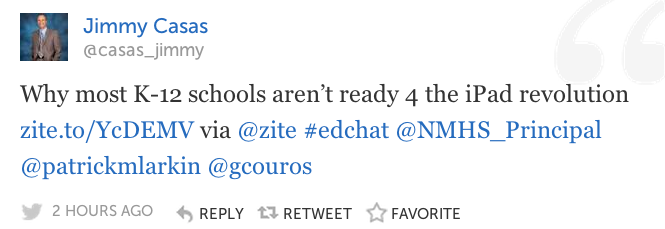
So I received the tweet below from a friend in Iowa this morning:

Being one of the first schools in our region to go all in on iPads at the high school level, I am always interested in reading the perspectives of others on this topic.  I think that there are a number of questions that need to be addressed for schools thinking about increasing the number of devices in their classrooms or moving towards a 1:1 program.  The post referenced in the tweet by my friend Jimmy, a high school Principal in Iowa, is worth a read for people looking at investing in iPads (or going 1:1 with any device).

The post, Why most K-12 schools aren’t ready for the iPad Revolution, cites four reasons that most schools are not prepared to purchase iPads for all students.  The four reasons cited by the author, Mike Reiners (CEO of Nomad), are as follows:

  1. Teaching requires planning.
  2. Consider where we’re spending our education dollars.
  3. The iPad is primarily a consumption device.
  4. Our students should be mobile multilingual.
Below are my thoughts on each of the points.

Teaching requires planning

Yes, I could not agree more. Our Superintendent is fond of saying, “Teaching is hard and Technology used to be hard. But even though the technology has gotten easier, the teaching is still hard and it will always be hard.”  Despite the fact that the technology is easier, the sheer number of resources available when you add web-enabled devices to the mix can be overwhelming.  I agree with Reiners point that thought and consideration and support are needed so that teachers have opportunities to prepare for this shift. In Burlington, we spend a year and a half before we had iPads teaching staff members about a variety of digital tools that they would be able to access and integrate into their curricular areas with any mobile device. We also focused on resources that we thought would save teachers time and could potentially increase student engagement.

Consider where we’re spending our education dollars

This consideration is one that we actually utilized to help us purchase our devices in Burlington. I am pretty sure that many schools do not spend enough time looking at what they are spending their money on now. What are some of the annually purchases that we make that we just don’t think about? (i.e. paper, printers, textbooks, computers, etc.) Our purchase of the iPads saved us in the vicinity of $100,000 due to the fact that we were looking at new options for a Foreign Language Lab and that does not take into consideration that most schools also add a para-professional to the mix to help maintain such a lab. We were also able to stop our annual expenditures on maintaining other labs in the building that were used primarily for word processing and research since the purchase of the devices allowed us to have this access in every classroom. Add in the fact, that we are no longer making large-scale textbook purchases for a course and we were well on our way to the amount needed to purchase our devices.


The iPad is primarily a consumption device

I’ve heard this one over and over, but I agree with the words of Scott Meech who hit on this topic a while back during the 2011 K-12 Online Conference in his session on “Purposeful Play:”

“Many argue that the iPad is the premiere consumption device at this time but it isn’t very good at creating. Is that accurate? I tend to believe that the iPad is an amazingly creative device and the user is the only limit for the device.”

Adam Webster also wrote a post on Edudemic a while back titled 5 Reasons The iPad Will Stay King Of The Classroom in which he stated:

“The iPad, its workflow and its apps, allow for real change and makes it easy. Your students will create work that not only wasn’t possible before their innovative use of the technology, but that you as their teacher had never even thought of.”

Our students should be mobile multilingual 

This definitely should be the goal for our students and I touched on this idea in a post back in January titled Is The iPad King? It Is For Us And That’s All That Matters (For Now). My concluding statement in the post was – “While I believe that we have made the best decision for our school today, things change quickly and we need to create organizational and individual flexibility to adapt to these changes when they occur.” 

Royan Lee wrote a wonderful post on this topic about a month ago on his blog titled “Why Mish-Mash Is Better Than 1:1.”  In the post he noted:

“I prefer teaching with the limitations of no class sets, because it means we’re constantly reflecting on the merits of each tool for the given purpose.”

The bottom line is that we need to make sure that the adults in the schools are modeling the flexibility and adaptability in their practice that our students are going to need to have to be successful. All of us who work in schools know that this is can be difficult since change is not something common in our traditional educational system and we have grown comfortable with many tools, workflows, and practices that are long outdated. 

In fact, the most important statement made in the post by Reiners is the one at the end which notes:

In summary, let’s think about what we’re doing. Blind, quick-trigger actions in education, especially expensive and invasive ones, have historically disastrous results.

I find this a bit ironic considering that some would say that we are exactly in this place with our mandated standardized testing and the development of the common core, two things that have certainly been expensive and invasive. While I could speculate on the results, that is probably best left for a future post.

The bottom line is that we don’t need any new devices in our schools, what we really need is new thinking in regards to our purpose for having schools. Any implementation of new gadgets and gizmos which strives to simply integrate them into our “traditional system” with teacher-focused learning environments instead of learner-centered environments is destined to have “disastrous results.”
Enhanced by Zemanta

Memorial School Celebrates Mrs. R – VIDEO

It has been a gift to work on the administrative team with Memorial School Principal Karen Rickershauser for the past six years. She is one of the most caring educators that I have ever met and she wears her love for her students, staff, and colleagues on her sleeve. 
I was fortunate to be at Memorial School on the final day of school this past Tuesday when she was recognized by the staff and students with a special send off (check out the video below).  As she heads off to Texas to be closer to her grandson Otto and other family members, I know that I am one of many that will miss her presence (and her hugs).