Moving Beyond The Textbook Is Nothing About A Book

This was cross-posted on EdTechTeacher

As we make the transition away from textbooks as the primary resource for teachers and classrooms, it is understandable that so many people are looking for THE ANSWER which would allow them make this change with as little struggle as possible. Why wouldn’t we do this when most of us have been “schooled” to think that there is always one right answer to a question?  There is a great comfort in knowing that there is a solution out there just waiting to be found, a solution that we can wrap our heads and hearts arounds and then settle down with for the next few decades.

In Burlington, we started looking for the “next-best thing” a couple of years ago when we hosted our first Digital Publication Collaborative. However, as we provided a space for educators to get together and create we realized that there were multiple options. As we move towards our third annual Massachusetts Digital Publication Collaborative in June, we see even more alternatives out there in regards to tools that educators can use to organize content.

Our effort is focused on trying to show educators as many of the options out there as possible and letting the educators (who are the learners in this case) make the choice that works best for them.  Because in my mind, if we can’t get educators to understand the power of “User-Generated Learning” then the choice of a textbook, an iBook, an eBook, or any other resource really doesn’t matter.   With predictions clear are that our students will enter careers that do not presently exist, we need to ensure that we arm them with the skills to continuously generate their own learning.

Dr. Kristen Swanson explains this change clearly in her book Professional Learning in the Digital Age:

“Instead of relying on a content area expert or textbook, (learners) are reliable for finding meaningful information.”

We look forward to bringing learners together again this June!

Enhanced by Zemanta

Checking Out Some Art Work In Our Middle School

As I have mentioned before, one of the favorite aspects of my job is getting into classrooms and seeing some of the neat work that students are doing. One thing I wanted to share today comes from Ms. Phillips’ Art Students. The two pictures below are from a sixth grader who was working in photoshop with a drawing she had originally done on paper (shown immediately below).
My Photo Stream-999

Then on the enhancement (shown below), the student took a background from a a real image and put it as the background on her drawing.

My Photo Stream-998

The second neat thing I took away from Ms. Phillips’ students was their use of Quick Response (QR) codes on their artwork. If you are not yet familiar with QR codes, you can see one on the leg of the football player on the right side of the picture below and another on the right-bottom corner of the image at the bottom of this post. Scanning these QR Codes brings viewers of these pieces to the blog of the artist where you can read their reflections on their work.

My Photo Stream-999
My Photo Stream-996

Enhanced by Zemanta

Our First BPS Tech Advisory Committee Meeting

We held the first meeting of our district Tech Advisory Committee yesterday. Please see the notes below and feel free to comment or ask questions in the comment section. The goal of this committee is to ensure that all stakeholders have the opportunity to communicate concerns and questions as we continue to move forward with our technology integration plans. Along with that, we want to continue to provide multiple opportunities for parents to learn how to use digital tools and how to support the use of these tools by their students.

Burlington Public Schools Technology Advisory Committee
March 26, 2013
  1. Introductions – Present: Mark Sullivan (BHS Principal), Josh Murphy (Director of Student Information), Bob Cunha (Director of Technology), Dennis Villano (Director of Instructional Technology), Eric Conti (Superintendent), Patrick Larkin (Assistant Superintendent), Andy Marcinek (BHS Staff), RJ Dalton (BHS Student), Sidd Chhayani (BHS Student), Lisa Koman (Parent), Michelle Feist (Parent), Paul Tsitsopoulos (Parent), Kristin Russo (School Committee).


  1. Update from each level – Director of Instructional Technology Dennis Villano updated the group on the Marshall Simonds Middle School 1:1 iPad program. Here is a link to his recent blog post on the middle school 1:1 efforts.  In addition, Dennis shared news on the pilots in the elementary schools and noted that all of the first grade pilot teachers felt that the program should be expanded to all first grade classrooms. The high school continues to progress with technology being integrated into classrooms and BHS Principal Mark Sullivan reported that most of his teachers are utilizing these resources comfortably.

  1. Plans for additional technology next year – We continue to prepare for PARCC testing which will replace MCAS in 2015 and will have to be delivered online. We are happy to report that Burlington is one of less than 25% of the districts in the state which is PARCC ready now.  Incorporate more devices so that we are 1:1 K-12 within two years. First grade pilot teacher are unanimous

  1. Supporting families/community – It was noted that there is a continued need to support parents in how to manage what the kids have access to and how to monitor it.  There was also a recommendation to share information about  the newest apps and social media resources that our students are using so that parents can stay up to speed. In addition it was noted that parents need continued training on how to stay on top of the latest news from the schools and that we should not forgo traditional means of communication (i.e. newspaper).  

  1. Questions/Concerns – What percentage of teachers are using the iPads in the classroom at the high school?   Mr. Sullivan put the number at about 90%.

Another question regarding the online PARCC assessment  was whether or not students would be able to use a paper and pencil if they preferred that or were uncomfortable with the online test.  In response, we noted that the accommodations have not been finalized but it is our assumption that all students are expected to take the assessment online.
There was also a question about iPads going home in grades K-8 as they currently do in the high school. With the main concerns at this point filtering out of school and breakage, we are unclear at this point what the plans for iPads going home in grades K-8. This will definitely be a topic of conversation at future meetings.
  
Other Useful Links regarding BPS EdTech  


Next Meeting – April 23, 2013 – 2:30-3:30 in the Marshall Simonds Learning Commons

Another Exciting Event For Connected Learners!

I wrote a post about a week ago regarding the opportunity our students had to connect with Kuato Studios as they worked to develop and release an exciting new app called Hakitzu, which teaches people how to code through a game where they control a robot and fight against another robot by entering code. Check out the video below that shows the game in action!

We are proud to be mentioned in the credits for the game (shown below) for this app which has already received positive reviews in day one of its release. Wired had a post titled Hakitzu-Promising AI Platform Blurs Lines Between Gaming and Learning. Others with reviews of the app included Touch Arcade and VentureBeat.

Camera Roll-225

Enhanced by Zemanta

But How Will Their Students Pass The State Assessment?

As our students in Massachusetts settle in for their annual round of “high-stakes” testing, I think it is the perfect time for people to take a few minutes to watch the video from TEDxCreativeCoast titled The Future Will Not Be Multiple Choice.  The presentation by Jaime McGrath (an elementary school teacher in Savannah, GA) and Drew Davies (a web designer) was posted on Mind Shift’s blog about a month ago and I forgot about it until I saw a tweet last night with the link. It really is a must watch for anyone who thinks that our current educational structure is adequate.

It’s no newsflash the current structure of most classrooms is unchanged from the structure that was created to educate students for an industrial society back in the 19th Century.  At one point in our history fitting the right piece in the right hole as quickly as possible and being able to retain large amounts of trivial information in order to regurgitate it or draw from it quickly may have actually been useful. However in a day and age where asking the right questions is of more value than providing a quick response to a multiple choice question, we are past the point of needing a change.

In fact the findings of educators like McGrath, who stray from the current script and look at problem-based education and a focus on “design thinking” are clear.

“All we did was give them the challenge, point them in the right direction and give them the space to be creative,” noted McGrath.  

Here are a few of my take-aways made by the co-presenters Jaime McGrath (an elementary school teacher in Savannah, GA) and Drew Davies (a web designer):

  • Reports predict that 65% of our students will be working in jobs that don’t exist yet.
  • “Such simple tasks as manipulation of blocks helps infants and toddlers develop early skills, including math literacy – the language of numbers.” Huttenlocher, Jordan, and Levine 1994
  • Don’t need students skilled in picking A, B, C, D 
  • “A true understanding of reality is not possible without a certain element of imagination…” Lev Vygotsky 
  • Design in education compliments all learning styles 
  • Will it be messy and risky? But what is the reality we are trying to prepare our kids for? 
  • The future is not a multiple choice test, it is a design challenge

So my question about the state assessment (or a national assessment) posed above was – “How will these students pass the state (or national) assessment. Here’s my answer –  “Who Cares!”

I think the bottom line is that students who are being taught in classrooms where they are being taught to think will be successful on any measure.

BPS Tech Advisory Committee To Meet Next Week

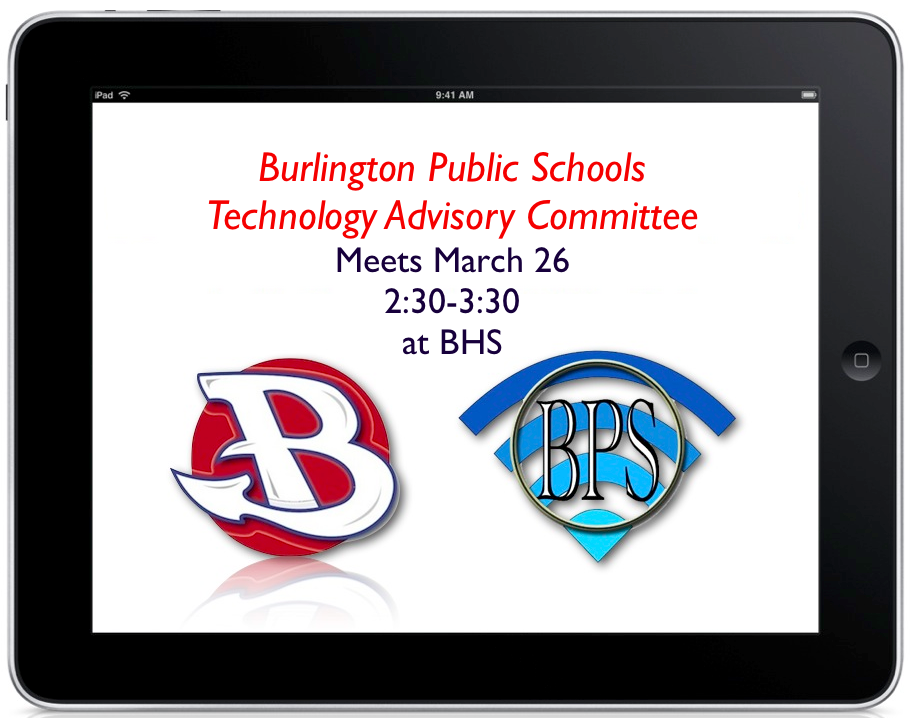
The initial meeting of our district’s Technology Advisory Committee will take place next Tuesday (March 26) at 2:30 at the high school.  This group, which will be comprised of parents, students, staff, and community members is being formed to provide feedback on various issues regarding technology integration in our school system.

As the technological landscape changes at an amazing pace, it is important that we include all stakeholders in the exciting conversations we will be involved in. In addition, we hope to expand our technology education offerings beyond our monthly Parent Technology nights to support even more individuals in our community. This group will play an important role in helping our district expand our collaborative and educational efforts in this area.

All our welcome to attend these meetings and offer their input. In addition, we will share a summary of what is discussed to ensure that interested individuals who cannot attend can remain in the loop.

School Connect App Live Today!!!

We are excited to offer a new way for Burlington families and staff to get updates from Burlington Public Schools! The School Connect App is now live and it will allow users to get updates on school closings and other important news sent directly to their smart devices.

In addition, there is a web-based service that also allows for users to get the same information. As we move forward, this will also allow individual schools, individual teachers, and clubs and activities to send out updates to interested parties.

 Please see the brief video below on how to get the School Connect App.

Another Example of How Building A Network Benefits Students

One of the exciting things about our high school (and school system) establishing a digital presence has been the doors that have been opened for staff and students to connect with others and build their own learning networks.  The video above is the most recent example, featuring Hannah Lienhard a sophomore at BHS. Hannah and (a few other BHS students) had an opportunity to beta test a new app (Hakitzu) from Kuato Studios that is due to be released in the app store in the next week and then provide feedback to the developers on the experience.  
There is another video that features a few more BHS students and some students from New Milford High School in New Jersey who also had an opportunity to try out the game which teaches students how to code by having them take on an opponent in a one-on-one battle where each player controls a robot.  The players then move the robot around an arena and deploy different weapons by writing code. 
Excitement around the release of this game has been building as evidenced by a recent feature on CNN.  These types of opportunities are available to more schools and students if they are willing to extend themselves and build a learning network for themselves. We truly believe that students that learn how to do this will have an advantage over those who do not. 

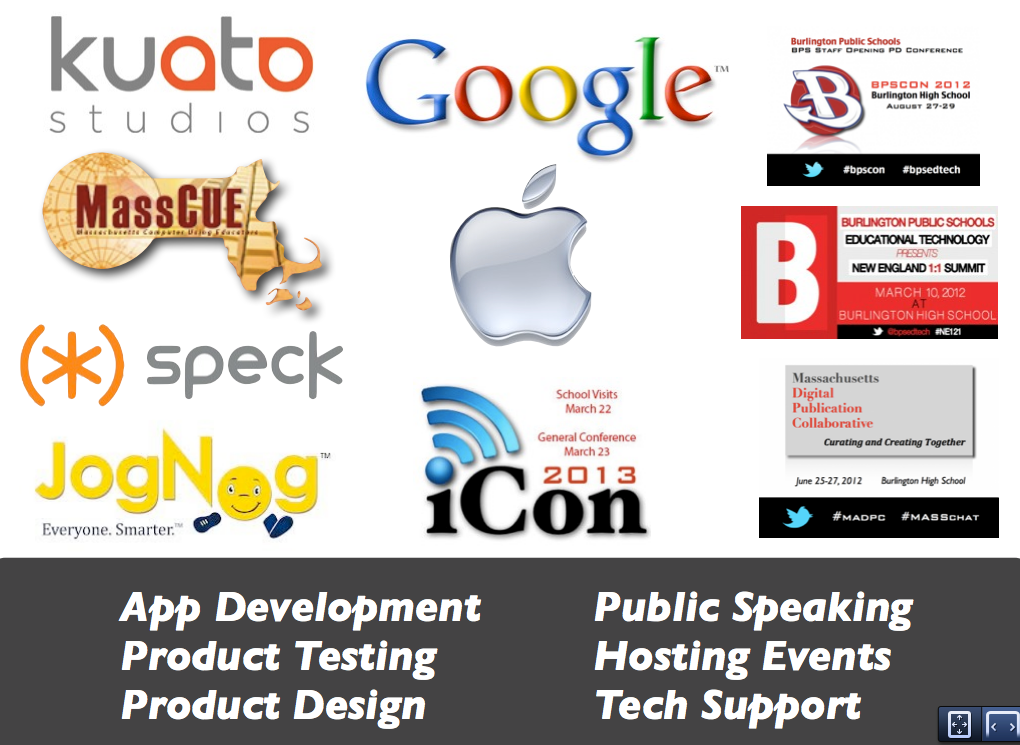
Here are a few other examples of the ways that our staff and students are connecting with others, building their learning networks, and establishing a digital identity. 

Enhanced by Zemanta

If Students Designed Their Own Schools (Video)

The video above first appeared in a Huffington Post article last week titled The Independent Project – High School Allows Teens To Decide Their Own Curriculum.   The clip gives an overview of a progressive program at Monument Mountain High School in Great Barrington, MA that allows students to design their own course of studies.

I can’t help wondering how many of our students would jump at the opportunity to do something similar…

Enhanced by Zemanta